
Everything About British Blue Point Cats: Characteristics, Temperament, and Care

Updated: Sep 23

British Blue Point Cat: Origin and History
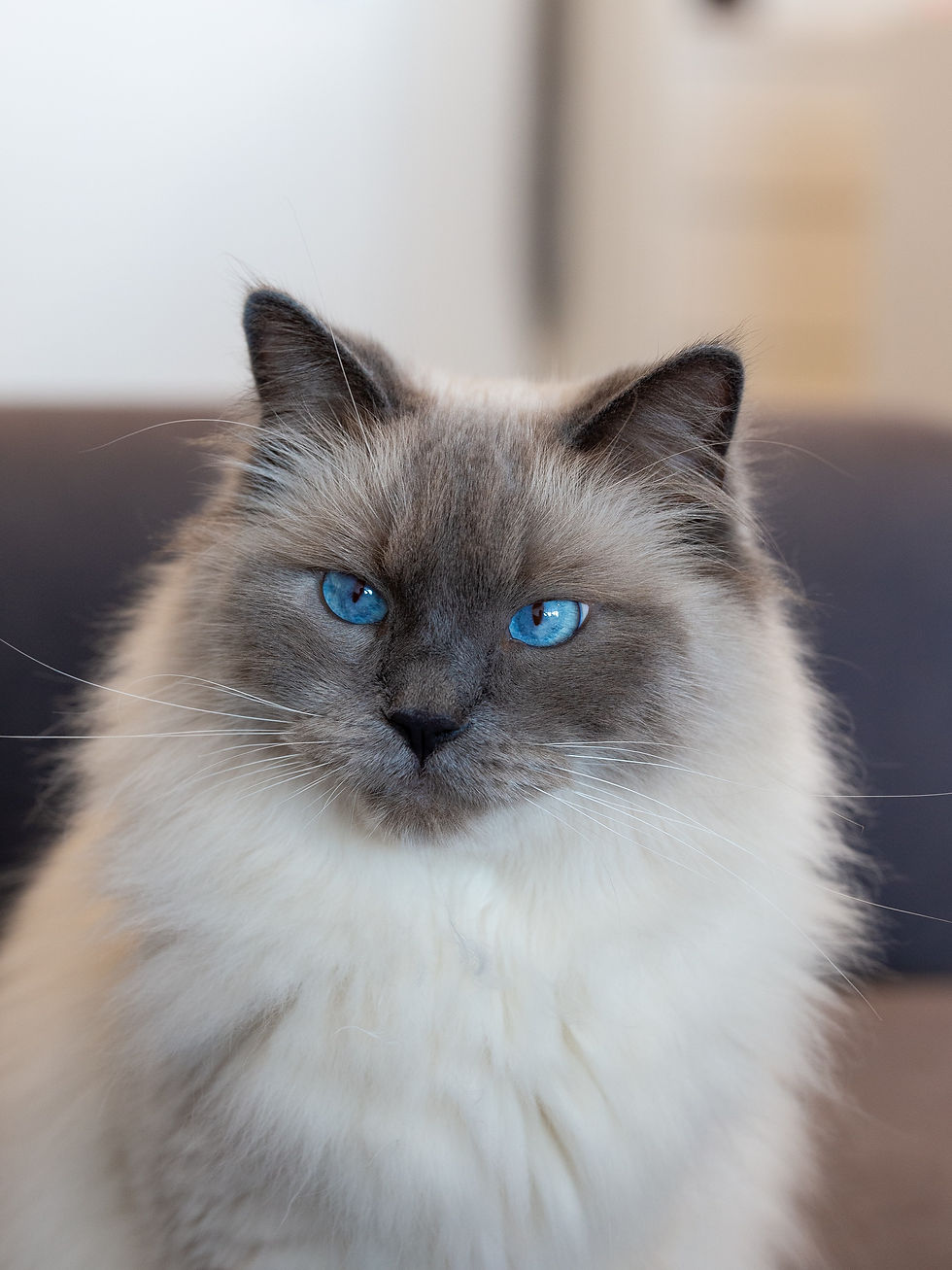
The British Blue Point cat originates from the British Shorthair. This is a unique and rarer color variation of the breed. This color type resulted from the combination of the strong genetic makeup of the classic British Shorthair and the point gene. The point pattern is characterized by darker coloration in cooler areas of the body such as the ears , face mask, paws, and tail. In the blue point variation, these dark areas are grey-blue in tone.
The British Shorthair breed traces its origins back to the Roman Empire. Short-haired cats brought to Britain by Roman legions adapted over centuries to England's harsh climate, developing into a strong, muscular, and durable breed. However, the blue point coloration was not naturally observed in these early periods. This trait emerged through controlled breeding programs in modern cat breeding.

Positive Characteristics of British Blue Point Cats
The British Blue Point cat is a breed that stands out not only for its aesthetic appearance but also for its character, adaptability to life, and overall behavioral balance. This variation, built on the solid foundations of British Shorthair genetics, is particularly preferred for its suitability for home life and calm temperament. Below, the prominent positive characteristics of the British Blue Point cat are presented in a table with detailed descriptions.
Positive attribute | Explanation |
Calm and Balanced Character | British Blue Point cats are generally not overly active or restless. They exhibit quiet, controlled, and calm behavior in daily life. This characteristic is a significant advantage, reducing stress levels within the home. |
Compatible with people | They can form a strong bond with their owners. While they don't constantly demand attention, they enjoy being in the same environment. They have a nature that follows their owner but doesn't overwhelm them. |
Quiet and Infrequent Meowing | British Blue Point cats don't meow loudly or frequently. They communicate primarily through eye contact and body language. This trait is particularly valuable for apartment living. |
Strong and Robust Structure | Due to their British Shorthair origins, they have a strong bone structure. Their robust build provides a significant advantage in terms of overall health throughout their lives. |
Child-friendly | Because they are not overly aggressive, they can be safely chosen for families with children. Thanks to their patient nature, they are less likely to react impulsively. |
Gets along with other pets. | When socialized early, they can live harmoniously with other cats and dogs. They generally don't cause problems with sharing space. |
Tolerant of Independence | They are one of the cat breeds that can be left alone for long periods. If the owner is working or not home during the day, this does not pose a significant stress source for a British Blue Point. |
Relatively Easy to Maintain | Thanks to its short and dense coat, the grooming routine is not complicated. Regular brushing easily maintains coat health. |
Aesthetic and Attractive Appearance | Blue point coloring offers an extremely elegant and sophisticated look thanks to the contrast between the light body color and the dark tip areas. |
Predictable Behavioral Pattern | Character traits are generally stable. Sudden aggression, extreme timidity, or unexpected behavioral changes are rare. |
These positive traits of the British Blue Point cat make it an ideal choice, especially for those who prefer a calm lifestyle and seek a tidy and peaceful home environment. Its balanced physical and behavioral nature ensures it will be a trouble-free housemate in the long term.

Negative Characteristics of British Blue Point Cats
While the British Blue Point cat is generally a balanced and adaptable breed, like any cat breed, it does possess some negative traits or characteristics that require attention . These traits should not be viewed as "problems"; rather, they should be considered as points that help determine whether the cat aligns with the owner's expectations. Below is a table detailing the potential negative aspects of the British Blue Point cat.
Negative trait | Explanation |
They are not a breed that craves excessive attention. | British Blue Point cats aren't cuddle bugs. They may not enjoy constant petting, being carried around, or forced physical contact. They prefer to control the amount of physical contact themselves. |
He/She might get too used to being alone. | Their tolerance for prolonged solitude can lead to decreased interaction with others in some individuals. This can develop into a distant personality if sufficient social connections are not established. |
The need for gaming may seem low. | Because they aren't overly active, some owners may perceive them as "indifferent" or "lazy." This can be particularly disappointing for those who want an energetic cat. |
British Shorthairs, due to their origins, may have good appetites. Combined with low activity levels, weight control can be difficult. If their feeding routine is not properly adjusted, the risk of obesity increases. | |
Sensitivity to Change | Sudden changes in living environment (moving, new pet, frequent rearrangement of furniture) can cause stress for some individuals. They tend to have a strong attachment to their habits. |
They may be distant towards strangers. | They don't immediately approach strangers during initial encounters. The socialization process can take time; this could be mistakenly interpreted as a "cold" personality. |
Their motivation towards education may be limited. | Despite being intelligent, some individuals may show little interest in reward- or game-based learning. It is important to remember that learning requires patience and consistency. |
The coat structure is prone to shedding. | Despite having short coats, they have a dense coat. If regular brushing isn't done, especially during seasonal changes, shedding can become noticeable. |
You may feel uncomfortable in extreme heat. | Due to their dense fur, they may be more comfortable in hot climates. Restlessness may occur if the room temperature is not properly regulated. |
These negative traits do not mean that the British Blue Point cat is a "difficult breed." On the contrary, these traits are easily manageable for owners who have well-defined expectations and a lifestyle compatible with this breed. The important thing is to know that this cat has a calm, dignified character and expects respect for its own space .

Physical Characteristics of the British Blue Point Cat
The British Blue Point cat retains the classic British Shorthair body structure while possessing a distinctive appearance thanks to the color contrast provided by the point pattern. Physical characteristics are presented below in clear tables and bullet points .
General Physical Structure Table
Feature | Explanation |
Body Type | Medium to large build, compact and muscular. |
Bone Structure | Thick and strong bones |
Breast Structure | Wide and deep |
Neck | Chunky |
Stance | Balanced, dignified, and solid. |
Head, Face, and Eye Features
Area | Detail |
Head Shape | Round and wide |
Cheeks | Full-bodied, particularly noticeable in adult men. |
Nose | Short, straight and wide |
Ears | Medium size, rounded ends, spaced apart. |
Eyes | Large, round, and usually in shades of blue. |
Note: In blue point cats, blue eye color is genetically linked to the point pattern, and this trait is important for breed standards.
Coat and Color Structure
Feature | Explanation |
Hair Length | Short |
Coat Structure | Dense, tight, and plush textured. |
Undercoat | Developed |
Body Color | Light cream–light gray tones |
Point Regions | Ears, face mask, paws, and tail. |
Point Color | Cool grey-blue |
Weight and Size Ranges
Gender | Average Weight |
Female | 3.5 – 5 kg |
Male | 5 – 7 kg |
British Blue Point cats generally have a large but not clumsy , balanced and strong physique. Their appearance becomes more "settled" and charismatic as they mature.

British Blue Point Cat Character and Behavioral Traits
The British Blue Point cat's character is as balanced and controlled as its physical appearance. Behavioral traits are described in detail below with lists and tables .
Table of Basic Character Traits
Behavioral Trait | Explanation |
Calm | It is peaceful and quiet in daily life. |
Independence | He can spend time alone. |
Emotional Balance | Sudden mood swings are rare. |
Patience | Tolerant of children and the home environment. |
Area Awareness | She expects respect for her own space. |
Relationship with its owner
The owner becomes attached to the owner but the owner is not overly dependent.
She doesn't like being held all the time.
Being in the same environment is enough for him.
It can silently follow its owner around the house.
Social Behaviors
Situation | Reaction |
Foreigners | Initially distant |
Children | Patient and controlled |
Other Cats | If they socialize early, they will be well-behaved. |
Dogs | He usually doesn't have problems with calm dogs. |
Approach to Play and Activity
He prefers short games.
It does not require long and intense activities.
They are more inclined towards mental games than physical games.
He/She becomes even calmer as he/she gets older.
Voice and Communication Features
Feature | Situation |
Low and quiet | |
Contact Method | Eye contact and body language |
Interest Request | Indirect and calm |
British Blue Point cats are ideally suited to a quiet, orderly, and low-stress lifestyle. Noisy, chaotic, and attention-demanding home environments are not suitable for this breed. Their temperament is patient, controlled, and predictable, making them less likely to cause problems in the long term.

Common Diseases in British Blue Point Cats
While British Blue Point cats are generally a robust breed, there are some breed predispositions associated with British Shorthair genetics and the point pattern. The table below summarizes the most common health issues in a clear and readable way.
Table of Common Diseases
Disease Name | Explanation | Predisposition Level |
This is one of the most common heart diseases in cats, characterized by thickening of the heart muscle. Regular heart checkups are important. | Middle | |
Polycystic Kidney Disease (PKD) | It is characterized by the formation of cysts in the kidneys. It is genetically inherited and may not show symptoms in the early stages. | Low - Medium |
Due to their low activity levels and large appetites, they are prone to weight gain. | Middle | |
Tooth and Gum Problems | Dental plaque, gingivitis, and bad breath may occur. | Middle |
Joint Stiffness and Arthritis | It can occur in older age, especially if there is excess weight. | Little |
Respiratory Sensitivity | Difficulty breathing can occur in extremely hot and stuffy environments. | Little |
Factors that Increase Susceptibility to Diseases
Irregular and high-calorie diet
Insufficient movement and play.
Excess weight
Parents who have not undergone genetic screening
Neglecting oral and dental care
Protective Approach List
General health check-up at least once a year.
Heart examinations should not be neglected.
Weight tracking and portion control.
Regular dental cleaning routine
Clean and cool living environment.
Most diseases in British Blue Point cats are preventable or can be controlled early . Therefore, regular check-ups are critical for the breed to live a long and healthy life.
British Blue Point Cat Intelligence and Learning Ability
Rather than being a breed known for high energy and quick intelligence, the British Blue Point cat possesses an intelligence structure based on balance, observation, and calm learning .
Intelligence Profile Chart
Area of Intelligence | Evaluation |
Problem Solving | Average – Good |
Learning Speed | Middle |
Memory | Good |
Perception of Routine | Very good |
Emotional Intelligence | High |
Learning Style Characteristics
It is adept at learning through repetition.
They adapt better to routines than to sudden commands.
There is reward motivation, but not excessive enthusiasm.
If pressured, he may lose interest completely.
Behaviors that are open to learning
Toilet training
Feeding and watering schedule
Daily routine hours
Getting used to the carrier and vet visits.
Simple games and puzzle toys
Things to Consider in Education
Approach | Its effect |
Patient and calm training | Very effective |
Coercive methods | Negative |
Reward-based approach | Average – Good |
Short repetitions | The most ideal method |
General Assessment of Intelligence Level
British Blue Point cat;
Not a "command receiving" area.
"Habit-forming"
It shapes its behavior by observing its owner.
It possesses a specific intellectual structure. Therefore, the educational process should be based on stability and continuity rather than quick results.
British Blue Point Cat Skin, Coat, Eye and Ear Care
Although British Blue Point cats have short coats, their dense and plush fur requires a regular but uncomplicated grooming routine. The grooming areas are presented below with clear tables and practical lists.
General Overview of Maintenance Areas
Area | Care Needs | Frequency |
Fur | Middle | 1–2 times a week |
Skin | Low | Observational based |
Eyelash | Middle | Once a week |
Ear | Middle | Once a month |
Claw | Middle | 1–2 times a month |
Hair Care Details
Criterion | Explanation |
Coat Structure | Short, frequent, and intense. |
Scanning Tool | Soft-bristled brush or rubber comb |
Seasonal Shedding | It increases in spring and autumn. |
Screening Benefit | Removal of dead hairs and skin ventilation. |
Things to keep in mind:
Excessively harsh combs can damage the coat structure.
Frequent washing is not recommended.
Skin redness should be checked during scanning.
Skin Health Monitoring
Flaking or dandruff is not normal.
Excessive fat accumulation may indicate a nutritional imbalance.
Sudden hair loss can be a sign of stress or metabolic problems.
Eye Care Chart
Situation | Approach |
Slight discharge | Gentle cleaning with damp cotton. |
Color change | It should be followed. |
Continuous watering | Environmental or health factors should be evaluated. |
Blue point cats naturally have blue eyes, but any color changes should be carefully monitored.
Ear Care Chart
Checkpoint | Normal | Abnormal |
Smell | None | Strong smell |
Stream | None | Dark color |
scratching | Rarely | Chic |
Paw and Paw Care
Nails should be checked regularly.
Overgrown nails can impair walking balance.
A scratching post should be provided.
British Blue Point Cat General Health and Lifespan
British Blue Point cats are one of the breeds that can live a long and healthy life with proper care and a balanced diet. Their overall health largely depends on their living conditions.
General Health Profile Table
Title | Evaluation |
Immune System | Good |
Genetic Resistance | Average – Good |
Diseases of Old Age | Controlled |
Stress Tolerance | High |
Environmental Compliance | Good |
Average Life Expectancy
Living Condition | Expected Time |
House Cat | 12-16 years |
well-groomed individuals | 17 years and older |
Irregular maintenance | 10-12 years |
Key Factors Affecting Health
Nutritional quality
Weight control
Movement and play level
Oral and dental care
Regular health checkups
Things to Consider During Old Age
Area | Suggestion |
Nutrition | Low-calorie, joint-supporting. |
Activity | Light but regular. |
Controls | At least twice a year |
Comfort | Warm, quiet living space |
Overall Assessment
British Blue Point cats, when properly cared for, can live an active and comfortable life well into old age. The breed's calm nature contributes to a lower incidence of stress-related illnesses.
Suitable Owner and Living Environment for British Blue Point Cats
The British Blue Point cat is a selective but not demanding breed that adapts more easily to a certain lifestyle. With the right owner profile and environment, it makes an extremely well-balanced housemate.
Suitable Owner Profile Table
Property Feature | Eligibility Status |
A calm lifestyle | Very Suitable |
Busy person | Suitable |
First-time cat adopter | Suitable |
Overprotective/cuddling owner | Partially Suitable |
noisy home environment | Less Suitable |
Expectations from the Owner
Not constant physical contact, but being in the same environment .
Regular but not intrusive attention
Daily routines should not change too often.
Non-intrusive gameplay and interaction.
Habitat Suitability Table
Environment | Level of Compatibility |
Apartment | Very good |
House with garden (controlled) | Middle |
Tiny house/1+1 | Good |
Crowded and noisy house | Low |
Things to Consider in the Home Environment
There should be quiet areas where they can rest.
Food, water, and litter box locations should be kept fixed.
Sudden changes of furniture and arrangement should be limited.
It should be protected from high temperatures.
Assessment for Families with Children
Situation | Explanation |
Little child | Patience is required, but supervision is necessary. |
school-aged children | Compatible |
Rough games | Not recommended |
The British Blue Point cat has a temperament that adapts to its owner's pace and enjoys peacefully existing in a corner of the house. It may not be suitable for those seeking an overly energetic cat that constantly demands attention.
British Blue Point Cat Lifespan and Reproduction Information
The breeding and life cycle of the British Blue Point cat largely overlaps with the genetics of the British Shorthair. However, genetic selectivity is more important in point-patterned cats.
Life Cycle Overview
Period | Features |
Puppy (0–6 months) | Rapid development, colors not yet fully developed. |
Young (6–18 months) | Physical strength increases, and color contrast becomes more pronounced. |
Adults (2–7 years) | The most balanced period |
Mature (7+ years) | Activity decreases, weight control becomes important. |
Reproductive Maturity
Gender | Reproductive Age |
Female | 7-10 months |
Male | 8-12 months |
Controlled and conscious mating is critical to ensuring that Point patterned puppies are healthy and meet the required standards.
Important Considerations Regarding Reproduction
Parents who have undergone genetic screening should be preferred.
Consanguineous mating should be avoided.
The first birth should not happen at a very young age.
Birthing intervals for females should be carefully planned.
The Subject of Sterilization
Title | Evaluation |
Behavioral influence | A calmer structure |
Health effect | Risks to the reproductive system are reduced. |
Weight risk | Diet needs to be adjusted. |
Suitable age | 5-7 months old |
Impact on Life Expectancy
Unplanned reproduction can cause stress.
Neutered individuals generally have a longer lifespan.
Maintaining hormonal balance ensures behavioral stability.
British Blue Point Cat Play and Activity Level
British Blue Point cats are not a high-energy breed that constantly demands play. Their activity needs are moderate to low , and they generally prefer short but meaningful interactions.
Activity Level Overview
Title | Evaluation |
Daily energy level | Medium - Low |
Game time | Short but organized. |
Changes with age | It decreases significantly. |
Physical endurance | Good |
The need for mental activity. | Middle |
Game Preferences
Short, calm games
Toys that provide mental stimulation
Interaction with the owner, but without coercion.
Routine games repeated at specific times of the day
Table of the Most Suitable Toy Types
Toy Type | Suitability |
Educational toys | Very Suitable |
Balls and light toys | Suitable |
Laser Toy | Short term |
Tunnels and hiding places | Suitable |
Climbing towers | Middle |
Suggested Game Frequency
Age Group | Suggested Game |
Baby | 2-3 short sessions per day |
Adult | 1-2 sessions per day |
Old | Depending on the need |
Possible Consequences of Lack of Physical Activity
Weight gain
Apathy and lethargy
Mental boredom
Increased sleep duration
For British Blue Point cats, regular and controlled activity is more important than constant movement . Strenuous exercise is not suitable for this breed.
British Blue Point Cat Feeding and Diet Recommendations
British Blue Point cats generally have a good appetite but are prone to weight gain . Therefore, their feeding plan must be controlled and balanced.
Nutrition Profile Chart
Title | Evaluation |
Appetite level | Medium - High |
Metabolism | Middle |
Risk of weight gain | Middle |
Protein requirements | High |
Water consumption | Middle |
Daily Nutrition Principles
High-quality protein-rich dog food.
Low carbohydrate content
Portion-controlled feeding
Feeding system instead of free feeding
Clean and readily available water
Evaluation Based on Food Types
Food Type | Suitability | Notes |
Dry food | Suitable | It should be given in moderation. |
wet food | Very Suitable | It supports water intake. |
Homemade diet | Partially | Balance is difficult to achieve. |
Cereal food | Less Suitable | It can increase the risk of weight gain. |
Suggested Number of Meals
Age | Daily Meal |
Kitten | 3–4 |
Adult | 2 |
Old | 2 (light portions) |
Things to Consider for Weight Control
Food size must be weighed
Treats should be used sparingly.
Daily physical activity should definitely be encouraged.
Monthly weight monitoring should be done.
Foods to Avoid in Your Diet
Continuous free feeding
High-fat foods
Human foods
Sudden changes in feeding
General Nutrition Assessment
The ideal diet for a British Blue Point cat is a feeding plan based on high protein, controlled calories, and regular meals . This approach helps with weight control and supports long-term overall health.
Frequently Asked Questions (FAQ) about British Blue Point Cats
Is the British Blue Point cat a British Shorthair, or a separate breed?
The British Blue Point cat is not a separate breed. It is a specific color and pattern variation of the British Shorthair breed. Its body structure, bone density, head shape, and temperament are the same as the British Shorthair. The only difference is the pointy coat color with blue-grey tones at the tips.
What is the difference between a British Blue Point cat and a British Blue cat?
British Blue cats have a solid grey-blue coat. In British Blue Point cats, the body is lighter in color, while the ears, facial mask, paws, and tail are a darker blue-grey. Also, Blue Point cats have blue eyes, while classic British Blue cats typically have amber or copper-toned eyes.
Why do British Blue Point cats have blue eyes?
Blue eye color is a genetic trait associated with the point pattern. This gene affects pigment distribution and causes the blue color to develop in the eyes. Blue eye color is a normal and expected characteristic in British Blue Point cats.
Do British Blue Point cats shed a lot of hair?
Despite having short fur , it sheds moderately due to its dense undercoat. Shedding may increase, especially during seasonal changes. This can be easily controlled with regular brushing 1-2 times a week.
Do British Blue Point cats like to be cuddled?
Generally, no. British Blue Point cats are affectionate, but they show it in a reserved way. They don't enjoy being constantly held. They prefer to be near their owners, in the same environment. They like to initiate physical contact themselves.
Do British Blue Point cats get along well with children?
Yes, she gets along particularly well with calm children who know their boundaries. She has a patient nature but doesn't enjoy rough play. Supervision is recommended when she is with young children.
Can a British Blue Point cat be left home alone?
Yes. This breed is tolerant of being alone. It's a suitable cat breed for people who work during the day. However, it's important that they aren't left completely unattended for long periods; even brief interaction in the evenings is crucial.
Are British Blue Point cats playful?
They are more active as puppies, but their desire to play decreases as adults. They prefer short, calm games. Mental toys and routine playtime are more suitable for them.
Are British Blue Point cats intelligent?
Yes, they are an intelligent breed, but they use their intelligence not through high energy, but through observation and habit . They learn routines quickly and adapt easily to home life. Patience and repetition are important in their training.
Are British Blue Point cats easy to train?
Basic habits (toilet training, using a carrier, daily routines) are easily learned. However, expectations such as command-based training are unrealistic. Coercive training methods can be counterproductive.
What diseases are British Blue Point cats prone to?
Hypertrophic cardiomyopathy (HCM), weight gain-related problems, and gum disease may be more common in this breed. With regular health checkups, these risks are largely manageable.
Do British Blue Point cats like warm weather?
No. Due to its dense fur, it can become overwhelming in hot weather. Cool, airy, and shaded environments are preferred.
Are British Blue Point cats suitable for apartment living?
Yes. Its quiet nature, low activity needs, and infrequent meowing make it extremely suitable for apartment living.
Do British Blue Point cats get along with other cats?
They are generally well-adjusted if socialized early. They are not dominant personalities, but they do want their own space to be respected.
Can British Blue Point cats live with dogs?
They can live with calm dogs that respect cats. Overly active and chasing dogs can cause stress.
Are British Blue Point cats prone to weight gain?
Yes. Due to low activity levels, weight gain can occur if portion control is not practiced. Meal-based feeding is recommended.
Is wet food or dry food more suitable for a British Blue Point cat?
Wet food is more advantageous as it supports water intake. However, a balanced diet can also include high-quality dry food. The ideal approach is to use both in balance.
How long do British Blue Point cats live?
With good care, the average lifespan is 12–16 years , and some individuals can live up to 17 years or more.
Should British Blue Point cats be neutered or spayed/neutered?
Yes. Sterilization improves behavioral stability and reduces health risks associated with the reproductive system. Weight control should also be considered.
Are British Blue Point cats suitable for first-time cat owners?
Yes. Because it's a calm, predictable breed that's easy to care for, it's suitable for first-time cat owners .
Are British Blue Point cats banned?
No. The British Blue Point cat is not a banned breed in Turkey or anywhere else in the world. There are no legal restrictions.
How much does a British Blue Point cat cost?
Prices vary depending on the country, breeder, and pedigree. In general:
Europe: middle-high
USA: high
Prices are higher for purebred and certified individuals.
Can British Blue Point cats cause allergies?
It is not completely hypoallergenic. However, due to its short fur, it may cause less allergic reactions in some people.
Are British Blue Point cats nocturnal?
No. It's not excessively active or noisy during the night. Its sleep patterns generally align with its owner's routine.
How does a British Blue Point cat react to changing owners?
Because they are a breed that is very attached to their habits, they may experience stress in the initial period. Patience, a calm environment, and maintaining routines will facilitate adaptation.
Sources
Cat Fanciers' Association (CFA)
The International Cat Association (TICA)
American Veterinary Medical Association (AVMA)
Mersin Vetlife Veterinary Clinic – Open on Map: https://share.google/XPP6L1V6c1EnGP3Oc


Comments