
How Much Food Should a Cat Eat Per Day? Feeding Chart by Weight, Age, and Food Type


How Much Food Should a Cat Eat Per Day?
The amount of food a cat should eat per day depends on its calorie requirement and the energy density of the food. Two cats with the same body weight may need different portions because of differences in age, neuter status, activity, body condition, metabolism, and health.
A practical daily portion can be calculated using:
Daily food amount (g) = daily calorie requirement (kcal) ÷ food energy density (kcal/g)
If the label lists energy as kcal/kg, divide that number by 1,000 to determine calories per gram.
Consider a healthy, neutered adult cat weighing 4 kg:
Calculation | Estimated result |
Resting Energy Requirement | Approximately 198 kcal/day |
Neutered adult factor | 1.2–1.4 × RER |
Estimated daily requirement | Approximately 238–277 kcal/day |
Dry food energy density | 3,800 kcal/kg |
Energy per gram | 3.8 kcal/g |
Estimated dry-food amount | Approximately 63–73 g/day |
The calculation is:
238 ÷ 3.8 = approximately 63 g
277 ÷ 3.8 = approximately 73 g
This does not mean every 4 kg cat should eat 63–73 g. An inactive indoor cat with a tendency to gain weight may need fewer calories, while a lean and active cat may need more.
The same calorie requirement also produces very different portions depending on food type:
Food | Energy density | Amount providing 250 kcal |
Lower-calorie dry food | 3,200 kcal/kg | 78 g |
Moderate-calorie dry food | 3,800 kcal/kg | 66 g |
Energy-dense dry food | 4,500 kcal/kg | 56 g |
800 kcal/kg | 313 g | |
Wet food | 1,000 kcal/kg | 250 g |
Wet food | 1,200 kcal/kg | 208 g |
A larger wet-food portion does not necessarily contain more calories because much of its weight comes from water.
A reliable feeding process includes:
Step | What to do |
1 | Determine the cat’s current and ideal weight |
2 | Estimate its daily calorie requirement |
3 | Find the food’s calorie content on the label |
4 | Convert calories into grams, cups, cans, or pouches |
5 | Include treats, supplements, and table food |
6 | Divide the daily amount into measured meals |
7 | Monitor body weight and body condition |
8 | Adjust the portion gradually when necessary |
Package feeding instructions are useful starting points but cannot perfectly predict an individual cat’s needs. The correct daily amount is the portion that maintains ideal body condition, stable weight, healthy muscle mass, normal activity, and appropriate stool quality.
Food should preferably be weighed with a digital kitchen scale. Small measuring errors are particularly important in cats because their daily portions are relatively small. An extra 10–15 g of calorie-dense kibble every day may represent a substantial caloric excess.
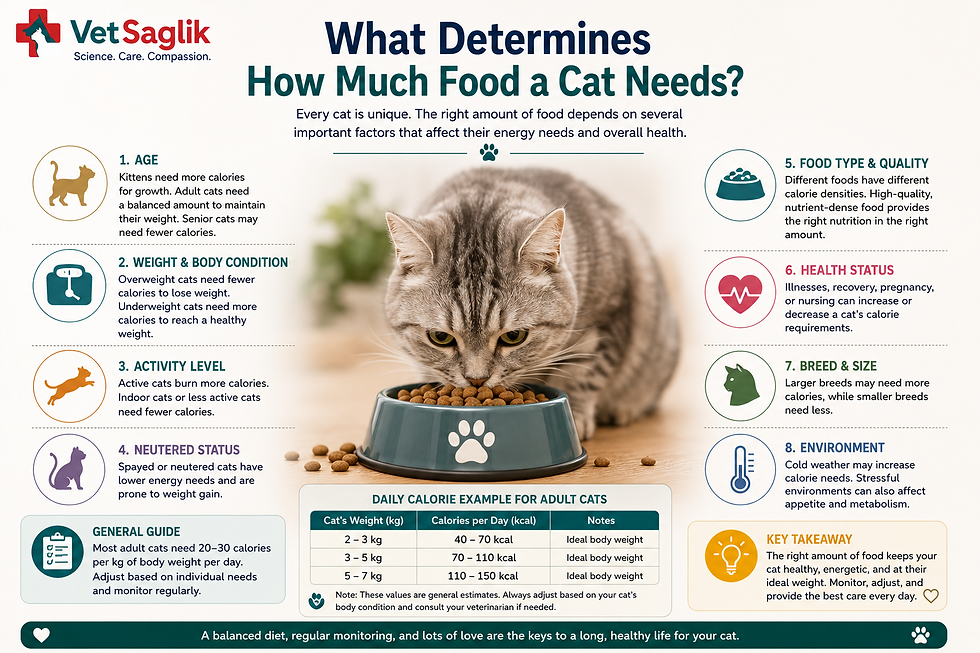
What Determines How Much Food a Cat Needs?
Body weight alone cannot determine the correct portion. Cats of equal weight may have substantially different energy requirements and nutritional needs.
Factor | How it may affect daily food needs |
Ideal body weight | Calorie calculations may need to use ideal rather than excess weight |
Body Condition Score | Overweight cats need controlled calories; thin cats require investigation and possible adjustment |
Muscle Condition Score | Muscle loss can occur even in cats that appear overweight |
Kittens need more energy for growth; requirements change again in mature and senior cats | |
Energy needs commonly decrease while appetite may increase | |
Activity level | Active cats generally require more calories than sedentary indoor cats |
Indoor or outdoor lifestyle | Indoor cats may have fewer opportunities for physical activity |
Individual metabolism | Cats of the same size and lifestyle can have different maintenance needs |
Pregnancy and lactation | Energy requirements increase, especially during milk production |
Food energy density | High-calorie food requires a smaller portion |
Wet or dry food | Moisture content significantly changes the portion’s weight and volume |
Treats and extras | All additional foods contribute to daily calories |
Health conditions | Kidney disease, diabetes, hyperthyroidism, gastrointestinal disease, and other conditions alter feeding needs |
Medication | Some medications affect appetite, weight, or metabolism |
Feeding method | Unlimited access can encourage overconsumption in some cats |
Household environment | Competition, stress, or multiple-cat feeding can alter intake |
Neutering deserves particular attention. Many cats become more food-motivated after neutering while their energy expenditure decreases. If the pre-neutering portion remains unchanged, gradual weight gain may occur.
Food type also has a major effect:
Example food | Energy density | Amount providing 200 kcal |
Dry food | 3,200 kcal/kg | 63 g |
Dry food | 4,000 kcal/kg | 50 g |
Dry food | 4,500 kcal/kg | 44 g |
Wet food | 800 kcal/kg | 250 g |
Wet food | 1,000 kcal/kg | 200 g |
Wet food | 1,200 kcal/kg | 167 g |
This is why statements such as “a 4 kg cat should eat 60 g per day” can be misleading unless the specific food’s calorie content is known.
A feeding calculation should always be tested against the cat’s response. At an ideal body condition, the ribs should be easy to feel beneath a light fat covering, a waist should be visible from above, and the abdomen should not appear excessively rounded or pendulous. Weight, body condition, and muscle condition should be assessed together.

Daily Calorie Requirements for Cats by Weight
The following table estimates daily calorie requirements using:
RER = 70 × body weight in kilograms^0.75
Maintenance calories are then estimated by multiplying RER by a factor representing the cat’s reproductive status and tendency to gain weight.
Cat’s ideal weight | RER | Inactive or obesity-prone | Neutered adult | Intact adult |
1 kg | 70 kcal | 70 kcal | 84–98 kcal | 98–112 kcal |
1.5 kg | 95 kcal | 95 kcal | 114–133 kcal | 133–152 kcal |
2 kg | 118 kcal | 118 kcal | 141–165 kcal | 165–188 kcal |
2.5 kg | 139 kcal | 139 kcal | 167–195 kcal | 195–223 kcal |
3 kg | 160 kcal | 160 kcal | 191–223 kcal | 223–255 kcal |
3.5 kg | 179 kcal | 179 kcal | 215–251 kcal | 251–287 kcal |
4 kg | 198 kcal | 198 kcal | 238–277 kcal | 277–317 kcal |
4.5 kg | 216 kcal | 216 kcal | 260–303 kcal | 303–346 kcal |
5 kg | 234 kcal | 234 kcal | 281–328 kcal | 328–374 kcal |
5.5 kg | 251 kcal | 251 kcal | 302–352 kcal | 352–402 kcal |
6 kg | 268 kcal | 268 kcal | 322–376 kcal | 376–429 kcal |
7 kg | 301 kcal | 301 kcal | 361–422 kcal | 422–482 kcal |
8 kg | 333 kcal | 333 kcal | 400–466 kcal | 466–533 kcal |
9 kg | 364 kcal | 364 kcal | 436–509 kcal | 509–582 kcal |
10 kg | 394 kcal | 394 kcal | 472–551 kcal | 551–630 kcal |
The columns use these starting factors:
Cat category | Calculation used |
Inactive or obesity-prone | Approximately 1.0 × RER |
Neutered adult | Approximately 1.2–1.4 × RER |
Intact adult | Approximately 1.4–1.6 × RER |
The table should be applied using the cat’s ideal weight. Using the current weight of an overweight cat may produce an excessive calorie target and slow or prevent weight loss.
These values are estimates rather than exact prescriptions. Cats of the same weight can differ substantially in the calories needed to maintain ideal body condition. Indoor activity, metabolism, muscle mass, age, and environmental enrichment all affect actual requirements.
The values represent calories—not grams, cups, cans, or pouches. A 4 kg neutered cat may initially require approximately 238–277 kcal daily, but the amount of food needed depends on the product:
Food energy density | Amount providing 250 kcal |
3,200 kcal/kg dry food | 78 g |
3,600 kcal/kg dry food | 69 g |
4,000 kcal/kg dry food | 63 g |
4,500 kcal/kg dry food | 56 g |
800 kcal/kg wet food | 313 g |
1,000 kcal/kg wet food | 250 g |
1,200 kcal/kg wet food | 208 g |
The table is not intended to provide a complete feeding prescription for kittens, pregnant or lactating cats, cats undergoing weight loss, or animals with medical conditions.
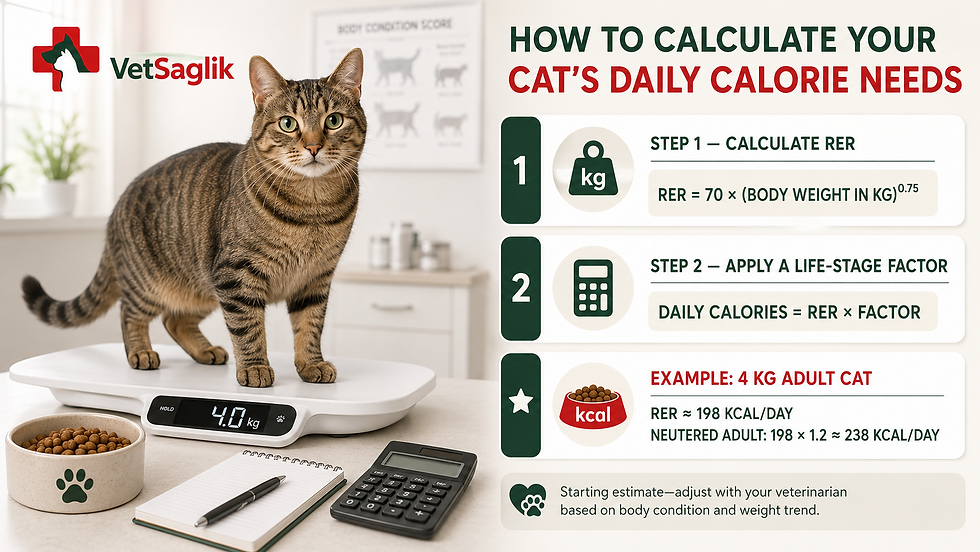
How to Calculate Your Cat’s Daily Calorie Needs
A cat’s daily calorie requirement can be estimated in two stages. First calculate the Resting Energy Requirement, or RER. Then multiply the RER by an appropriate life-stage factor to estimate the Maintenance Energy Requirement, or MER.
Step 1: Calculate RER
The standard formula is:
RER = 70 × body weight in kilograms^0.75
For cats weighing between approximately 2 and 45 kg, a simplified formula may also be used:
RER = (30 × body weight in kilograms) + 70
The two formulas produce slightly different estimates. The exponential formula can be applied across a wider weight range and will be used throughout these tables.
Step 2: Calculate MER
MER = RER × life-stage factor
Consider a healthy, neutered adult cat weighing 4 kg:
Calculation step | Result |
Body weight | 4 kg |
RER | Approximately 198 kcal/day |
Neutered adult factor | 1.2–1.4 |
Lower MER estimate | 238 kcal/day |
Upper MER estimate | 277 kcal/day |
If the cat is an inactive indoor cat with a tendency to gain weight, the initial target may need to be closer to RER. If the cat is lean, active, and maintaining stable weight, a higher value within the neutered range may be appropriate.
Converting the result into dry-food grams
If the food contains 3,800 kcal/kg:
3,800 ÷ 1,000 = 3.8 kcal/g
Daily calorie target | Calculation | Dry food per day |
238 kcal | 238 ÷ 3.8 | Approximately 63 g |
250 kcal | 250 ÷ 3.8 | Approximately 66 g |
277 kcal | 277 ÷ 3.8 | Approximately 73 g |
Converting the result into wet food
If the wet food contains 1,000 kcal/kg, it provides 1 kcal per gram:
Daily calorie target | Wet food per day |
238 kcal | 238 g |
250 kcal | 250 g |
277 kcal | 277 g |
If one pouch provides 80 kcal:
Daily calorie target | Pouches per day |
238 kcal | Approximately 3 pouches |
250 kcal | Approximately 3.1 pouches |
277 kcal | Approximately 3.5 pouches |
The calculation should use calories per pouch rather than pouch weight alone. Two 85 g pouches can have different calorie contents.
All calorie sources must be counted:
Daily item | Example calories |
Main food | 220 kcal |
Treats | 15 kcal |
Food used for medication | 10 kcal |
Nutritional supplement | 5 kcal |
Total daily intake | 250 kcal |
Calculated requirements should be treated as a starting point. Monitor weight, waist definition, abdominal shape, Body Condition Score, and muscle mass. Adjust the accurately measured portion gradually if the cat gains or loses unintended weight.
Cat Calorie Multipliers by Age and Reproductive Status
After calculating RER, multiply it by the factor that best represents the cat’s life stage, reproductive status, activity, and body condition.
Cat category | Suggested starting multiplier |
Inactive or obesity-prone adult | Approximately 1.0 × RER |
Neutered adult | Approximately 1.2–1.4 × RER |
Intact adult | Approximately 1.4–1.6 × RER |
Kitten during growth | Approximately 2.5 × RER |
Weight-loss program | Approximately 0.8 × RER based on ideal weight |
Approximately 1.6–2.0 × RER | |
Lactation | Approximately 2.0–6.0 × RER |
Mature adult, approximately 7–10 years | Often near RER; adjust individually |
Senior cat older than 10 years | No universal factor; reassess weight, muscle, and digestion |
These multipliers estimate calories rather than the nutritional composition of the food. Kittens, pregnant cats, lactating cats, and cats undergoing weight loss require diets formulated for their specific nutritional needs.
Neutered cats: Neutering can reduce energy expenditure while increasing appetite. A cat that continues eating the same unlimited portion after neutering may gradually gain weight. Male cats can be particularly prone to post-neutering obesity.
Inactive indoor cats: Cats with limited activity may require calories close to RER. However, indoor status alone does not determine the correct factor. Play, climbing, hunting-style feeding, metabolism, age, and muscle mass must also be considered.
Kittens: Growing kittens require substantially more energy per kilogram than adults. A single 2.5 × RER calculation is only a starting estimate because calorie requirements change quickly during growth. Food should be complete and balanced for kitten growth.
Pregnant and lactating cats: Energy requirements rise during pregnancy and become much higher during lactation. Litter size, milk production, body condition, and stage of lactation all influence intake. Multiple meals and energy-dense kitten food are often appropriate.
Weight loss: A calorie target for an overweight cat should normally be based on ideal weight and supervised carefully. Cats must not undergo sudden, severe food restriction because rapid weight loss and prolonged inadequate intake can increase the risk of hepatic lipidosis.
Senior cats: Many middle-aged cats gain excess fat as activity decreases. However, some cats older than 10 years lose weight and muscle because of reduced digestion or underlying disease. Senior cats should not automatically receive fewer calories.

Cat Feeding Chart by Weight
The following chart estimates daily dry-food amounts for a healthy, neutered adult cat at ideal body condition. Calculations use approximately 1.2 × RER.
Four energy-density columns are included because the same calorie requirement can produce very different gram portions.
Cat’s ideal weight | Estimated calories | 3,200 kcal/kg food | 3,600 kcal/kg food | 4,000 kcal/kg food | 4,500 kcal/kg food |
1 kg | 84 kcal | 26 g | 23 g | 21 g | 19 g |
1.5 kg | 114 kcal | 36 g | 32 g | 28 g | 25 g |
2 kg | 141 kcal | 44 g | 39 g | 35 g | 31 g |
2.5 kg | 167 kcal | 52 g | 46 g | 42 g | 37 g |
3 kg | 191 kcal | 60 g | 53 g | 48 g | 43 g |
3.5 kg | 215 kcal | 67 g | 60 g | 54 g | 48 g |
4 kg | 238 kcal | 74 g | 66 g | 59 g | 53 g |
4.5 kg | 260 kcal | 81 g | 72 g | 65 g | 58 g |
5 kg | 281 kcal | 88 g | 78 g | 70 g | 62 g |
5.5 kg | 302 kcal | 94 g | 84 g | 75 g | 67 g |
6 kg | 322 kcal | 101 g | 89 g | 81 g | 72 g |
7 kg | 361 kcal | 113 g | 100 g | 90 g | 80 g |
8 kg | 400 kcal | 125 g | 111 g | 100 g | 89 g |
9 kg | 436 kcal | 136 g | 121 g | 109 g | 97 g |
10 kg | 472 kcal | 148 g | 131 g | 118 g | 105 g |
To use the chart:
Find the cat’s ideal weight.
Check the food label for kcal/kg.
Select the closest energy-density column.
Use the listed amount as an initial daily portion.
Subtract calories supplied by treats and other foods.
Divide the remaining amount into measured meals.
Monitor weight and body condition before adjusting.
If the food contains a calorie density not listed in the table, calculate:
Daily grams = required daily calories ÷ (kcal/kg ÷ 1,000)
For example, a 4 kg neutered cat requires approximately 238 kcal and eats food containing 3,850 kcal/kg:
3,850 ÷ 1,000 = 3.85 kcal/g
238 ÷ 3.85 = approximately 62 g/day
This calculated amount may still be too high for an inactive or obesity-prone cat. If 1.0 × RER were used for the same 4 kg cat, the target would be approximately 198 kcal:
198 ÷ 3.85 = approximately 51 g/day
That 11 g difference may appear small, but with calorie-dense cat food it represents approximately 42 kcal daily.
4 kg cat example | Daily calories | Food at 3,850 kcal/kg |
Obesity-prone: 1.0 × RER | 198 kcal | 51 g |
Neutered: 1.2 × RER | 238 kcal | 62 g |
Neutered and active: 1.4 × RER | 277 kcal | 72 g |
Intact: 1.6 × RER | 317 kcal | 82 g |
This chart should not be applied unchanged to kittens, pregnant or lactating cats, senior cats losing weight, or cats with medical conditions. The correct portion is ultimately determined by the cat’s weight trend, Body Condition Score, Muscle Condition Score, and clinical health.
How to Convert Calories Into Grams, Cups, Cans, or Pouches
Once the cat’s daily calorie target is known, it must be converted using the calorie information on the specific food package.
Label information | Calculation |
kcal/kg | Divide by 1,000 to calculate kcal per gram |
kcal/100 g | Daily calories ÷ kcal per 100 g × 100 |
kcal/cup | Daily calories ÷ kcal per cup |
kcal/can | Daily calories ÷ kcal per can |
kcal/pouch | Daily calories ÷ kcal per pouch |
Consider a cat requiring 240 kcal per day.
Food format | Label value | Amount providing 240 kcal |
Dry food | 3,200 kcal/kg | 75 g |
Dry food | 3,600 kcal/kg | 67 g |
Dry food | 4,000 kcal/kg | 60 g |
Dry food | 400 kcal/cup | 0.6 cup |
Wet food | 120 kcal/can | 2 cans |
Wet food | 80 kcal/pouch | 3 pouches |
Wet food | 100 kcal/100 g | 240 g |
Converting kcal/kg into grams
If dry food contains 3,600 kcal/kg:
3,600 ÷ 1,000 = 3.6 kcal/g
For a cat requiring 240 kcal:
240 ÷ 3.6 = approximately 67 g/day
Converting calories into cans
If one can provides 120 kcal:
240 ÷ 120 = 2 cans/day
The weight of the can alone does not determine how many cans the cat should eat. Two cans of equal size may contain different calorie amounts.
Converting calories into pouches
If one pouch provides 80 kcal:
240 ÷ 80 = 3 pouches/day
If the result is not a whole number, the remaining pouch must be stored according to the manufacturer’s refrigeration and storage instructions.
Mixed feeding
When dry and wet foods are combined, assign a calorie allowance to each food before calculating the portion. Do not feed the full dry-food allowance and then add wet food.
For a 240 kcal target divided equally between dry and wet food:
Food | Calorie allocation | Energy density | Daily amount |
Dry food | 120 kcal | 3.6 kcal/g | Approximately 33 g |
Wet food | 120 kcal | 80 kcal/pouch | 1.5 pouches |
Total | 240 kcal | — | 33 g dry + 1.5 pouches |
Another cat may receive 25% of its calories from dry food and 75% from wet food:
Food | Calorie allocation | Daily amount |
Dry food at 3.6 kcal/g | 60 kcal | Approximately 17 g |
Wet food at 80 kcal/pouch | 180 kcal | 2.25 pouches |
Total | 240 kcal | 17 g dry + 2.25 pouches |
Measuring cups are less accurate than weighing food. A small difference in cup filling can represent a meaningful proportion of a cat’s total daily intake. A digital kitchen scale is the preferred method for measuring dry food.
Always use the calorie statement from the current package. Energy density can differ between flavours, package sizes, countries, and reformulated versions of the same product.
Kitten Feeding Chart by Age and Weight
Kittens need substantially more energy relative to body weight than adult cats because they are growing rapidly. Their calorie requirements are highest during early growth and gradually decline as they approach adulthood.
A commonly used starting calculation for a healthy growing kitten is:
Daily calories = approximately 2.5 × RER
The calculation should use the kitten’s current weight, not its predicted adult weight.
The following table uses 2.5 × RER. Dry-food amounts assume a kitten food containing 4,000 kcal/kg, or 4 kcal/g.
Kitten’s current weight | Estimated calories | Dry kitten food at 4,000 kcal/kg |
0.5 kg | 104 kcal | 26 g |
0.75 kg | 141 kcal | 35 g |
1 kg | 175 kcal | 44 g |
1.5 kg | 237 kcal | 59 g |
2 kg | 294 kcal | 74 g |
2.5 kg | 348 kcal | 87 g |
3 kg | 399 kcal | 100 g |
3.5 kg | 448 kcal | 112 g |
4 kg | 495 kcal | 124 g |
5 kg | 585 kcal | 146 g |
These estimates should not be used unchanged throughout the entire first year. Energy requirements per kilogram decline as growth slows. At approximately 10 weeks, a kitten may require around 200 kcal/kg/day, whereas a 10-month-old kitten may require closer to 80 kcal/kg/day.
Kitten’s age | Feeding considerations | Typical meals per day |
3–5 weeks | Gradual weaning onto complete kitten food | 4 or more small meals |
6–12 weeks | Very rapid growth and high energy requirement | 4 meals |
3–6 months | Continued rapid growth; reassess portions frequently | 3–4 meals |
6–9 months | Growth continues but energy needs begin declining | 2–3 meals |
9–12 months | Gradual approach toward adult requirements | 2–3 meals |
Around 12 months | Most cats can transition to adult maintenance food | Usually 2 or more meals |
Food should be labelled as complete and balanced for growth or all life stages. Adult maintenance food may not supply growing kittens with the appropriate concentration of energy and essential nutrients.
Wet, dry, or mixed feeding can be used if the products are suitable for growth. For a kitten requiring 300 kcal daily:
Food option | Energy information | Approximate daily amount |
Dry kitten food | 4,000 kcal/kg | 75 g |
Wet kitten food | 100 kcal/100 g | 300 g |
Kitten pouches | 100 kcal/pouch | 3 pouches |
Mixed feeding | 150 kcal dry + 150 kcal wet | 38 g dry + 150 g wet |
Kittens should be weighed regularly because their needs change quickly. The portion should support steady growth without producing excessive body fat. Ribs should remain easy to feel beneath a light fat covering, and a waist should be visible without the kitten appearing thin or bony.
Reduced appetite in a young kitten requires prompt attention. Small kittens have limited energy reserves and can become unstable more quickly than healthy adult cats. Persistent food refusal, vomiting, diarrhea, weakness, or failure to gain weight warrants veterinary assessment.
How Much Should Adult and Neutered Cats Eat?
A healthy adult cat should receive enough calories to maintain ideal body weight, muscle mass, and a Body Condition Score of approximately 4–5/9. The correct portion depends strongly on neuter status and activity level.
Neutering frequently reduces energy requirements while appetite may increase. Continuing unlimited feeding or maintaining the same pre-neutering portion can therefore cause gradual weight gain.
Adult cat category | Suggested starting calculation |
Inactive or strongly obesity-prone | Approximately 1.0 × RER |
Neutered adult | Approximately 1.2–1.4 × RER |
Intact adult | Approximately 1.4–1.6 × RER |
Highly active adult | Begin within the appropriate range and adjust individually |
The following table shows how these factors affect daily calories and dry-food amounts. Gram values assume food containing 3,600 kcal/kg.
Ideal weight | Obesity-prone: 1.0 × RER | Neutered: 1.2 × RER | Neutered/active: 1.4 × RER | Intact/active: 1.6 × RER |
2 kg | 118 kcal / 33 g | 141 kcal / 39 g | 165 kcal / 46 g | 188 kcal / 52 g |
3 kg | 160 kcal / 44 g | 191 kcal / 53 g | 223 kcal / 62 g | 255 kcal / 71 g |
4 kg | 198 kcal / 55 g | 238 kcal / 66 g | 277 kcal / 77 g | 317 kcal / 88 g |
5 kg | 234 kcal / 65 g | 281 kcal / 78 g | 328 kcal / 91 g | 374 kcal / 104 g |
6 kg | 268 kcal / 74 g | 322 kcal / 89 g | 376 kcal / 104 g | 429 kcal / 119 g |
7 kg | 301 kcal / 84 g | 361 kcal / 100 g | 422 kcal / 117 g | 482 kcal / 134 g |
8 kg | 333 kcal / 93 g | 400 kcal / 111 g | 466 kcal / 129 g | 533 kcal / 148 g |
9 kg | 364 kcal / 101 g | 436 kcal / 121 g | 509 kcal / 141 g | 582 kcal / 162 g |
10 kg | 394 kcal / 109 g | 472 kcal / 131 g | 551 kcal / 153 g | 630 kcal / 175 g |
The calculation must use ideal weight. A 10 kg cat should not automatically be assigned the 10 kg row because many cats at this weight are obese. Large-framed breeds and genuinely lean, muscular cats are exceptions that require individual assessment.
Neutering does not mean every cat should receive exactly 1.2 × RER. A lean and highly active neutered cat may maintain ideal condition closer to 1.4 × RER, while an inactive indoor cat may require intake near RER.
Portions should be reassessed after neutering:
Observation after neutering | Possible response |
Stable weight and ideal body condition | Maintain the current measured intake |
Increasing appetite but stable weight | Avoid adding unmeasured food; use enrichment and scheduled portions |
Gradual weight gain | Review treats and reduce total calories carefully |
Loss of waist definition | Reassess Body Condition Score and daily intake |
Reduced activity | Adjust calorie allowance rather than meal frequency alone |
Unexpected weight loss | Arrange veterinary assessment |
Free-choice feeding can predispose some cats to overconsumption because it makes daily intake difficult to measure. Scheduled portions, puzzle feeders, hunting-style feeding, and multiple small meals can provide enrichment while preserving calorie control.
Weight and body condition should be checked within a few weeks of changing the feeding plan. Small daily excesses matter: an additional 10 g of food containing 3,600 kcal/kg provides 36 extra calories, which may represent more than 10% of a small cat’s daily requirement.
How Much Food Should Senior Cats Eat?
There is no universal portion or calorie multiplier for every senior cat. Feline energy requirements may change in different directions as cats age.
Many mature adult cats between approximately 7 and 10 years become less active and gain excess fat. In contrast, some cats older than 10 years experience reduced digestive efficiency, weight loss, and muscle loss and may require more calories rather than less.
Life stage or condition | Typical nutritional concern |
Mature adult, approximately 7–10 years | Reduced activity and gradual weight gain |
Senior, older than approximately 10 years | Increased risk of muscle and weight loss |
Stable ideal condition | Maintain the current measured intake |
Increasing body fat | Review calories, treats, and activity |
Muscle loss with stable body weight | Assess protein intake and underlying disease |
Unexplained weight loss | Veterinary examination before simply increasing food |
Reduced appetite | Investigate dental disease, pain, nausea, and systemic illness |
Poor digestion | Consider food digestibility and gastrointestinal evaluation |
A mature cat maintaining appropriate condition may require daily calories close to RER. Some cats older than 10 years may need approximately 10–20% more energy, and occasionally more, to maintain body weight and muscle. This increase is not appropriate for every senior cat and should be guided by regular monitoring.
Consider a 4 kg senior cat:
Feeding situation | Approximate daily target |
Near RER | 198 kcal |
10% above RER | 218 kcal |
20% above RER | 238 kcal |
25% above RER | 248 kcal |
Daily calorie target | Approximate dry-food amount |
198 kcal | 52 g |
218 kcal | 57 g |
238 kcal | 63 g |
248 kcal | 65 g |
These values demonstrate how a relatively small gram adjustment can meaningfully change a cat’s calorie intake.
Senior cats should be monitored for both body fat and muscle:
What to monitor | Why it matters |
Body weight | Detects gradual gain or loss |
Body Condition Score | Estimates body-fat level |
Muscle Condition Score | Detects muscle loss that body weight may hide |
Appetite | Changes may be an early sign of disease |
Water intake and urination | May change with kidney disease, diabetes, or hyperthyroidism |
Vomiting and stool quality | May indicate gastrointestinal or systemic disease |
Chewing and food dropping | May reveal dental or oral pain |
Mobility | Pain and arthritis may reduce access to food |
Grooming and coat quality | Can decline with pain, disease, or malnutrition |
Senior cats should not automatically receive a low-protein diet. Adequate high-quality protein is important for preserving muscle unless a diagnosed medical condition requires a specific therapeutic formulation.
Unexplained weight loss, increased appetite with weight loss, excessive thirst, frequent urination, vomiting, diarrhea, or muscle wasting may occur with chronic kidney disease, hyperthyroidism, diabetes, gastrointestinal disease, dental disease, or other conditions. These signs require veterinary assessment rather than portion adjustment alone.
Dry Food, Wet Food, or Mixed Feeding: How Much Should You Give?
Dry and wet cat foods contain very different amounts of water and calories. They cannot be compared gram for gram, and the same number of grams may provide substantially different calorie amounts.
Feature | Dry food | Wet food |
Typical moisture | Approximately 3–11% | Approximately 60% to more than 87% |
Typical calorie density | Approximately 320–450 kcal/100 g | Approximately 70–130 kcal/100 g |
Portion weight | Smaller | Larger |
Water contribution | Low | High |
Measurement | Preferably weighed in grams | Grams, cans, trays, or pouches |
Storage after opening | Usually easier | Usually requires refrigeration |
Palatability | Varies | Often highly palatable |
Cost per calorie | Often lower | Often higher |
These ranges are illustrative. Some foods fall outside them, so the exact calorie statement on the package must always be used.
Consider a cat requiring 240 kcal per day:
Food type | Energy density | Amount providing 240 kcal |
Dry food | 3,200 kcal/kg | 75 g |
Dry food | 3,600 kcal/kg | 67 g |
Dry food | 4,000 kcal/kg | 60 g |
Dry food | 4,500 kcal/kg | 53 g |
Wet food | 800 kcal/kg | 300 g |
Wet food | 1,000 kcal/kg | 240 g |
Wet food | 1,200 kcal/kg | 200 g |
A larger wet-food portion does not necessarily mean that the cat is being overfed. Much of the additional weight is water.
Wet food can increase dietary water intake, which may be useful for cats that drink relatively little. However, wet food does not automatically prevent urinary or kidney disease, and the most appropriate diet depends on the individual cat’s health.
Mixed feeding
Dry and wet foods may be combined if their calories are calculated as parts of the same daily allowance. Feeding the complete dry-food portion and then adding wet food usually results in excess calories.
For a cat requiring 240 kcal, a 50:50 calorie split could be:
Food component | Calorie allocation | Energy density | Daily amount |
Dry food | 120 kcal | 3,600 kcal/kg | Approximately 33 g |
Wet food | 120 kcal | 1,000 kcal/kg | 120 g |
Total | 240 kcal | — | 33 g dry + 120 g wet |
A 25:75 split could be:
Food component | Calorie allocation | Daily amount |
Dry food at 3.6 kcal/g | 60 kcal | Approximately 17 g |
Wet food at 1 kcal/g | 180 kcal | 180 g |
Total | 240 kcal | 17 g dry + 180 g wet |
All foods used as the main diet should be complete and balanced for the cat’s life stage. Adding large amounts of plain meat, fish, dairy products, or homemade food may unbalance the overall diet even when the calorie total appears correct.
Dry food should be weighed rather than estimated by eye. Wet-food leftovers should be covered, refrigerated, and discarded according to package instructions. Food left at room temperature for prolonged periods may spoil and become unpalatable.
When changing diet type, introduce the new food gradually when possible. Cats can develop food aversion or gastrointestinal upset after sudden changes. Offering the new food separately at first may help preserve acceptance of the existing diet.
How Much Wet Food Should a Cat Eat Per Day?
The amount of wet food a cat should eat depends on the cat’s daily calorie target and the wet food’s calories per gram, can, tray, or pouch.
The following table estimates daily wet-food amounts for healthy, neutered adult cats using approximately 1.2 × RER.
Cat’s ideal weight | Estimated calories | Wet food at 80 kcal/100 g | Wet food at 100 kcal/100 g | Wet food at 120 kcal/100 g |
2 kg | 141 kcal | 176 g | 141 g | 118 g |
2.5 kg | 167 kcal | 209 g | 167 g | 139 g |
3 kg | 191 kcal | 239 g | 191 g | 159 g |
3.5 kg | 215 kcal | 269 g | 215 g | 179 g |
4 kg | 238 kcal | 298 g | 238 g | 198 g |
4.5 kg | 260 kcal | 325 g | 260 g | 217 g |
5 kg | 281 kcal | 351 g | 281 g | 234 g |
5.5 kg | 302 kcal | 378 g | 302 g | 252 g |
6 kg | 322 kcal | 403 g | 322 g | 268 g |
7 kg | 361 kcal | 451 g | 361 g | 301 g |
8 kg | 400 kcal | 500 g | 400 g | 333 g |
9 kg | 436 kcal | 545 g | 436 g | 363 g |
10 kg | 472 kcal | 590 g | 472 g | 393 g |
The calculation must use ideal weight. A cat weighing 8 or 10 kg because of obesity should not automatically receive the corresponding high-calorie portion.
Calculating cans or pouches
Divide the daily calorie requirement by the calories in one unit.
For a cat requiring 240 kcal:
Package calorie content | Daily amount |
70 kcal per pouch | Approximately 3.4 pouches |
80 kcal per pouch | 3 pouches |
100 kcal per pouch | 2.4 pouches |
120 kcal per can | 2 cans |
150 kcal per can | 1.6 cans |
200 kcal per can | 1.2 cans |
Package weight and calorie content are not interchangeable. An 85 g pouch may contain 65 kcal, 80 kcal, 100 kcal, or another amount depending on the formulation.
If a 4 kg cat needs approximately 238 kcal and one 85 g pouch provides 80 kcal:
238 ÷ 80 = approximately 2.98 pouches/day
The starting amount would therefore be approximately three pouches per day, assuming the pouches provide complete and balanced nutrition and no other food is given.
If the cat also receives 20 g of dry food containing 3.8 kcal/g:
20 × 3.8 = 76 kcal from dry food
The remaining wet-food allowance becomes:
238 − 76 = 162 kcal
With an 80 kcal pouch:
162 ÷ 80 = approximately two pouches
The daily plan would be approximately:
Food | Daily amount | Calories |
Dry food | 20 g | 76 kcal |
Wet food | Approximately 2 pouches | 160 kcal |
Total | — | 236 kcal |
Wet food intake should be divided into multiple fresh meals when practical. Cats that consistently leave part of each serving may benefit from smaller portions offered more frequently rather than larger amounts remaining in the bowl.
How Many Meals Should a Cat Eat Per Day?
The cat’s total daily calorie allowance should be calculated first and then divided into meals. Increasing meal frequency should not increase the total amount of food offered.
Cats naturally tend to consume multiple small meals. Providing several measured portions can better reflect this pattern than offering one or two very large meals.
Cat’s age or condition | Typical daily meal frequency |
Recently weaned kitten | 4 or more small meals |
Kitten aged approximately 2–3 months | 4 meals |
Kitten aged approximately 3–6 months | 3–4 meals |
Kitten aged approximately 6–12 months | 2–3 meals |
Healthy adult cat | At least 2 meals; often 3–5 smaller portions |
Healthy senior cat | 2–4 meals according to appetite and tolerance |
Pregnant cat | Multiple small meals |
Lactating cat | Frequent meals or individually managed access |
Cat with a medical condition | According to the veterinary feeding plan |
The daily amount can be divided as follows:
Daily allowance | Two meals | Three meals | Four meals | Five meals |
40 g | 20 g | Approximately 13 g | 10 g | 8 g |
50 g | 25 g | Approximately 17 g | 12.5 g | 10 g |
60 g | 30 g | 20 g | 15 g | 12 g |
75 g | 37.5 g | 25 g | Approximately 19 g | 15 g |
100 g | 50 g | Approximately 33 g | 25 g | 20 g |
Automatic feeders can provide multiple measured portions during the day or night. Puzzle feeders and food-hunting activities can also slow eating, encourage movement, and provide mental stimulation.
Measured feeding compared with free-choice feeding
Feeding method | Advantages | Potential disadvantages |
Measured meals | Accurate calorie control and easier appetite monitoring | Requires a consistent schedule |
Multiple small measured meals | Reflects natural feline eating behaviour | Requires planning or an automatic feeder |
Puzzle or hunting-style feeding | Encourages activity and mental engagement | Must still use the measured daily allowance |
Free-choice dry feeding | Convenient and allows frequent eating | Can promote overconsumption and hide appetite changes |
Separate feeding in multi-cat homes | Allows individual portion control | Requires separate locations or controlled access |
Free-choice feeding is not appropriate for every cat. Some cats regulate their intake successfully, while others repeatedly eat more calories than needed. Unlimited food is particularly risky for inactive, neutered, and obesity-prone cats.
Multi-cat homes require additional planning. One cat may consume food intended for another, making portion control impossible. Cats should be fed in separate areas or with controlled-access feeders when weight, age, diet, or medical needs differ.
Changes in appetite are important health indicators. Measured feeding makes it easier to notice whether a cat is eating less than usual. A cat that suddenly refuses food, particularly an overweight cat, should not simply be observed for several days because prolonged inadequate intake can increase the risk of hepatic lipidosis.
How Much of a Cat’s Daily Intake Can Come From Treats?
Treats, table food, supplements, and food used to administer medication should generally provide no more than 10% of a healthy cat’s total daily calories. At least 90% should come from a complete and balanced diet suitable for the cat’s life stage.
Daily calorie requirement | Maximum calories from treats | Calories remaining for complete food |
150 kcal | 15 kcal | 135 kcal |
180 kcal | 18 kcal | 162 kcal |
200 kcal | 20 kcal | 180 kcal |
220 kcal | 22 kcal | 198 kcal |
240 kcal | 24 kcal | 216 kcal |
260 kcal | 26 kcal | 234 kcal |
280 kcal | 28 kcal | 252 kcal |
300 kcal | 30 kcal | 270 kcal |
350 kcal | 35 kcal | 315 kcal |
400 kcal | 40 kcal | 360 kcal |
The 10% limit is a maximum, not a target. Cats do not need treats to obtain complete nutrition, and cats undergoing weight management may need considerably fewer.
Treat calories can accumulate quickly relative to a cat’s small daily requirement:
Extra food | Illustrative calorie amount |
Small commercial cat treat | 1–5 kcal |
Larger crunchy or filled treat | 5–15 kcal |
Lickable treat tube | 5–20 kcal |
Small piece of cooked meat | 10–30 kcal |
Food used to hide medication | Varies |
Milk, cream, cheese, or table food | Can add substantial calories |
These are examples only. Check the product label or obtain calorie information from the manufacturer.
Consider a cat with a daily target of 240 kcal:
Daily item | Calories |
Complete cat food | 216 kcal |
Training or enrichment treats | 10 kcal |
Lickable treat | 14 kcal |
Total | 240 kcal |
If the cat receives the full 240 kcal portion of complete food and then receives the same treats, total intake becomes 264 kcal. This is a 10% daily excess and may gradually cause weight gain.
Part of the regular food allowance can be reserved for play, training, puzzle feeders, or rewarding desired behaviour. This provides enrichment without adding extra calories.
Treats should not replace complete food. Feeding large quantities of plain meat, fish, liver, dairy products, or homemade snacks can reduce the proportion of essential nutrients in the overall diet.
Human foods containing onions, garlic, chocolate, caffeine, alcohol, grapes, raisins, or xylitol should not be given. Bones and raw animal products may also create nutritional, dental, gastrointestinal, or infectious risks.
How to Adjust Portions Using Body Condition Score
Calculated calorie requirements and package feeding directions are starting points. A cat’s Body Condition Score, or BCS, helps determine whether the current portion is maintaining an appropriate amount of body fat.
The commonly used nine-point system assesses the ribs, waist, abdomen, and fat deposits.
BCS | Interpretation | Typical physical findings |
1/9 | Emaciated | Ribs, spine, and pelvic bones clearly visible; severe fat and muscle loss |
2/9 | Very thin | Ribs easily visible; minimal fat; marked abdominal tuck |
3/9 | Thin | Ribs easy to feel and may be visible; pronounced waist |
4/9 | Lean and generally ideal | Ribs easy to feel with minimal fat covering; clear waist |
5/9 | Ideal | Ribs palpable beneath a light fat covering; visible waist and appropriate abdominal shape |
6/9 | Slightly overweight | Ribs palpable with mild excess covering; waist less obvious |
7/9 | Overweight | Ribs difficult to feel; rounded abdomen and noticeable fat deposits |
8/9 | Obese | Ribs difficult or impossible to feel; little waist; substantial abdominal fat |
9/9 | Severely obese | Extensive fat deposits; markedly rounded abdomen; no visible waist |
A healthy target for many cats is approximately 4–5/9. The normal primordial pouch—a loose fold of skin and fat along the lower abdomen—should not be mistaken for obesity by itself. The ribs, waist, spine, abdomen, and overall silhouette must be assessed together.
Body-condition finding | Possible feeding response |
BCS 4–5/9 with stable weight | Maintain the current measured intake |
BCS 3/9 or declining weight | Investigate the cause and consider a controlled increase |
BCS 6/9 with gradual weight gain | Review extras and reduce calories carefully |
BCS 7–9/9 | Arrange a structured veterinary weight-loss plan |
Normal BCS with muscle loss | Assess Muscle Condition Score and investigate disease |
Rapid or unexplained weight change | Seek veterinary assessment before making major adjustments |
For a healthy cat with mild unwanted weight gain, the current accurately measured intake may initially be reduced by approximately 5–10%, followed by reassessment.
Current daily portion | 5% reduction | 10% reduction |
40 g | 38 g | 36 g |
50 g | 47.5 g | 45 g |
60 g | 57 g | 54 g |
70 g | 66.5 g | 63 g |
80 g | 76 g | 72 g |
100 g | 95 g | 90 g |
Severe calorie restriction is not appropriate. Simply feeding a much smaller amount of ordinary maintenance food may reduce essential protein, vitamin, and mineral intake. Overweight cats also face a risk of hepatic lipidosis if food intake drops suddenly or prolonged fasting occurs.
Body weight should be monitored after a portion adjustment:
What to monitor | Suggested approach |
Body weight | Recheck approximately every 2–4 weeks |
Body Condition Score | Assess monthly |
Muscle Condition Score | Assess during routine veterinary examinations |
Actual food intake | Measure daily |
Treats and extras | Record every source |
Appetite | Observe at every meal |
Activity and play | Monitor for meaningful changes |
Muscle Condition Score should be assessed separately from BCS. A cat may carry excess body fat while losing muscle over the spine, shoulder blades, skull, or hips. Reducing calories without recognizing muscle loss may worsen the problem.
Signs You May Be Feeding Your Cat Too Much or Too Little
The feeding amount is likely appropriate when the cat maintains stable ideal weight, a BCS of approximately 4–5/9, healthy muscle mass, normal activity, and consistent stool quality.
Area assessed | Possible overfeeding | Possible underfeeding |
Body weight | Progressive weight gain | Progressive weight loss |
Ribs | Difficult to feel beneath fat | Highly prominent or visible |
Waist | Reduced or absent | Excessively narrow or pronounced |
Abdomen | Rounded appearance or increased fat | Marked abdominal tuck |
Fat deposits | Increased over ribs, abdomen, and tail base | Minimal fat covering |
Muscle mass | May be hidden beneath excess fat | Loss over spine, shoulders, skull, or hips |
Mobility | Reduced jumping, play, or grooming | Weakness and reduced activity |
Grooming may decline with obesity | Dull coat or poor grooming | |
Stool | Larger, more frequent, or softer stool | Small stool volume or constipation in some cats |
May remain strong despite excess intake | Persistent hunger or food-seeking | |
General behaviour | Reduced activity or exercise tolerance | Restlessness, weakness, or lethargy |
Hunger does not always mean that a cat needs more calories. Food-seeking may be influenced by habit, boredom, environmental stress, competition, feeding routine, highly palatable food, or medication.
Weight loss does not always mean that the portion is too small. Cats may lose weight despite adequate or increased intake because of hyperthyroidism, diabetes, gastrointestinal disease, kidney disease, dental pain, cancer, parasites, or other conditions.
Finding | Recommended response |
Slow weight gain with otherwise normal health | Measure every food and review total calories |
Mild excess body condition | Reduce calories gradually and increase enrichment |
Unexpected weight loss | Arrange veterinary examination |
Increased appetite with weight loss | Seek veterinary assessment promptly |
Food refusal | Determine urgency according to duration and accompanying signs |
Muscle loss despite stable weight | Evaluate diet quality and underlying disease |
Vomiting, diarrhea, or poor stool quality | Investigate rather than changing the portion alone |
Increased thirst or urination | Arrange veterinary assessment |
Difficulty chewing or dropping food | Examine the mouth and teeth |
Reduced jumping or grooming | Assess pain, arthritis, obesity, and systemic illness |
A cat should not be placed on an aggressive diet without veterinary guidance. Weight loss must be gradual, nutritionally complete, and monitored. Sudden food restriction or complete refusal to eat is more dangerous in cats than in many other species because of the risk of hepatic lipidosis.
When Should a Veterinarian Calculate Your Cat’s Diet?
General feeding charts are designed mainly for healthy cats at or near ideal body condition. A veterinarian or veterinary nutrition professional should calculate or review the diet when the cat has a medical condition, abnormal weight, unusual energy requirements, or unexplained appetite changes.
Situation | Why an individualized feeding plan may be needed |
Obesity | Calorie restriction must remain nutritionally complete and avoid rapid weight loss |
Severe underweight condition | The cause must be identified, and refeeding may need careful management |
Chronic kidney disease | Phosphorus, protein quality, sodium, energy, and hydration may require modification |
Diabetes mellitus | Food composition, portion size, and meal timing may need coordination with insulin |
Hyperthyroidism | Calorie needs may be high before treatment and change after thyroid control |
Liver disease | Diet depends on the diagnosis, severity, and risk of hepatic complications |
Gastrointestinal disease | Digestibility, fiber, fat, protein source, or meal frequency may need adjustment |
Pancreatitis or hyperlipidemia | Fat and total calorie intake may require closer control |
Urinary tract disease | Moisture, minerals, urine concentration, and therapeutic formulation may matter |
Food allergy or adverse food reaction | A structured elimination diet may be required |
Pregnancy or lactation | Requirements rise and change rapidly |
Growing kitten with poor weight gain | Calories and nutrient intake must support controlled growth |
Senior cat losing weight or muscle | Underlying disease and reduced digestion must be assessed |
Dental or oral disease | Food texture and meal presentation may require adaptation |
Long-term medication use | Some medications alter appetite, weight, glucose, or metabolism |
Home-prepared diet | Calories alone cannot confirm nutritional completeness |
A complete nutritional assessment may include:
Current and ideal body weight
Weight history
Body Condition Score
Muscle Condition Score
Exact food, treat, and supplement intake
Food calorie density
Meal schedule and feeding method
Life stage and reproductive status
Indoor activity and environmental enrichment
Medical conditions and medications
Blood, urine, or imaging results
Follow-up weight and body measurements
A diet is not appropriate solely because it provides the calculated number of calories. It must also contain adequate protein, taurine, essential fatty acids, vitamins, minerals, and other nutrients required by cats.
Home-prepared diets require particular caution. Meat, fish, liver, eggs, rice, or supplements combined without a professionally formulated recipe may supply enough calories while remaining deficient or excessive in essential nutrients.
Prompt veterinary assessment is appropriate when a cat stops eating and is also vomiting, weak, painful, dehydrated, jaundiced, struggling to breathe, or showing neurological signs. Kittens, diabetic cats, overweight cats, and cats with chronic disease may become unstable more quickly.
Frequently Asked Questions
How much food should a cat eat per day?
The correct amount depends on the cat’s ideal weight, age, neuter status, activity, body condition, health, and the food’s calorie density. Calculate daily calorie needs first, then convert the result into grams, cups, cans, or pouches using the food label.
How many grams of dry food should I feed my cat?
There is no universal gram amount based only on body weight. A 4 kg neutered cat may initially need approximately 238 kcal. This equals about 74 g of a 3,200 kcal/kg food but only 53 g of a 4,500 kcal/kg food.
How much wet food should a cat eat daily?
Divide the cat’s daily calorie requirement by the wet food’s calories per gram, can, tray, or pouch. A cat requiring 240 kcal would need three pouches if each pouch contains 80 kcal.
Should I feed my cat once or twice a day?
Most adult cats should receive at least two measured meals, although three to five smaller portions may better reflect natural feline feeding behaviour. The total daily calorie allowance must remain unchanged regardless of meal frequency.
Is free-choice feeding safe for cats?
Some cats regulate their intake, but free-choice feeding can encourage overeating and make appetite changes difficult to detect. Measured meals are generally preferable for neutered, inactive, overweight, or food-motivated cats.
Do neutered cats need less food?
Many neutered cats require fewer calories while experiencing increased appetite. Their portions, weight, and body condition should be reviewed after neutering to reduce the risk of gradual obesity.
Can I mix wet and dry cat food?
Yes. Calculate the calories supplied by each food and keep their combined total within the daily allowance. Do not provide the full dry-food portion and then add wet food without reducing the dry amount.
How much should a kitten eat per day?
A common starting estimate for a healthy growing kitten is approximately 2.5 × RER, calculated from current weight. Requirements change rapidly during growth, so portions should be reassessed frequently and complete kitten food should be used.
How much of a cat’s diet can consist of treats?
Treats and other extras should generally provide no more than 10% of total daily calories. At least 90% should come from a complete and balanced food appropriate for the cat’s life stage.
How do I know whether I am overfeeding my cat?
Possible signs include progressive weight gain, ribs becoming difficult to feel, loss of waist definition, a rounded abdomen, reduced jumping, and difficulty grooming. A Body Condition Score above 5/9 suggests the feeding plan should be reviewed.
Why is my cat always hungry despite eating enough?
Food-seeking may result from habit, boredom, competition, medication, or individual temperament. Persistent hunger accompanied by weight loss, increased thirst, vomiting, diarrhea, or restlessness may indicate conditions such as hyperthyroidism or diabetes and requires veterinary evaluation.
Should senior cats eat less?
Not always. Some mature cats need fewer calories as activity declines, while cats older than 10 years may need more energy because of reduced digestion, weight loss, or muscle loss. Portion decisions should be based on the individual cat rather than age alone.
What should I do if my cat suddenly stops eating?
A sudden loss of appetite should be taken seriously, particularly in kittens, overweight cats, diabetic cats, and cats with chronic disease. Contact a veterinarian promptly if food refusal persists or occurs with vomiting, weakness, pain, jaundice, dehydration, or other abnormal signs.
Sources
Official source | Open link |
World Small Animal Veterinary Association — Global Nutrition Guidelines | |
American Animal Hospital Association — Nutrition and Weight: Kittens | |
American Animal Hospital Association — Nutrition and Weight: Young Adult Cats | |
American Animal Hospital Association — Nutrition and Weight: Mature Adult and Senior Cats | |
AAHA/AAFP — 2021 Feline Life Stage Guidelines | |
American Animal Hospital Association — Feeding Plans for Healthy, Appropriate-Weight Cats and Dogs | |
American Animal Hospital Association — Weight Reduction in the Obese Pet | |
Merck Veterinary Manual — Daily Maintenance Energy Requirements for Dogs and Cats | |
Merck Veterinary Manual — Nutritional Requirements of Small Animals | |
U.S. Food and Drug Administration — Complete and Balanced Pet Food | |
Association of American Feed Control Officials — Reading Pet Food Labels | |
Association of American Feed Control Officials — Calorie Content | |
Mersin Vetlife Veterinary Clinic |


Comments