
What Is a Primordial Pouch in Cats? Causes, Purpose, and When to Worry

Updated: Jun 29
What Is a Primordial Pouch?
A primordial pouch is a loose flap of skin, fat, and connective tissue that hangs along the lower abdomen of many cats. It is located in front of the hind legs and may sway from side to side when a cat walks or runs.
Many cat owners mistake a primordial pouch for excess weight, but it is actually a normal part of feline anatomy. Even cats that are fit and healthy can have a noticeable pouch. The size of the pouch varies from cat to cat and may become more visible as a cat ages.
Unlike abdominal swelling caused by illness, a primordial pouch is soft, flexible, and does not usually cause pain or discomfort.
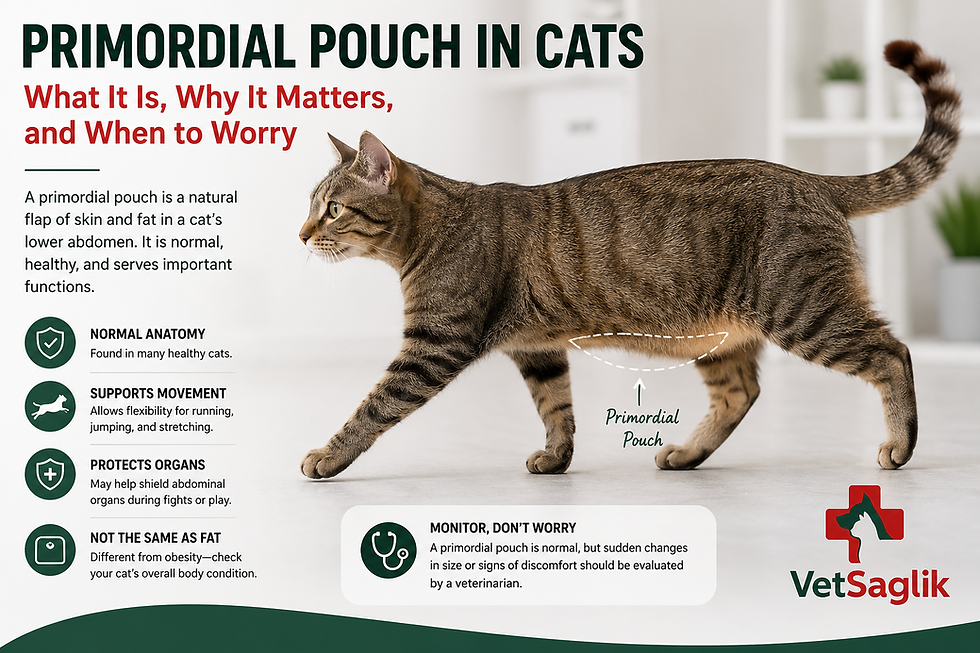
Why Do Cats Have a Primordial Pouch?
The exact evolutionary purpose of the primordial pouch is still debated, but experts believe it provides several advantages.
Protection for Vital Organs
The loose skin may help protect a cat's abdomen during fights or rough play by providing an extra layer over important organs.
Greater Flexibility and Movement
A primordial pouch allows the abdominal area to stretch more easily. This flexibility can help cats extend their bodies when running, jumping, climbing, or making sudden turns.
Energy Storage
The pouch also contains a small amount of fat tissue, which may have helped wild ancestors store extra energy during periods when food was scarce.
For modern house cats, the primordial pouch remains a normal anatomical feature and is usually not a sign of a medical problem.

Do All Cats Have a Primordial Pouch?
Most cats have a primordial pouch, although its size and appearance can vary significantly. In some cats, the pouch is barely noticeable, while in others it can be quite prominent.
Several factors influence how visible a primordial pouch becomes:
Breed
Certain breeds are known for having larger or more noticeable primordial pouches. These include:
Egyptian Mau
Japanese Bobtail
Pixiebob
However, mixed-breed cats and domestic shorthairs can also develop a clearly visible pouch.
Age
As cats grow older, the skin and tissues around the abdomen may become less firm. This can make the primordial pouch appear larger, even when the cat's weight remains stable.
Genetics
Just like coat color or body shape, the size of the primordial pouch can be influenced by genetics. Some cats naturally have a more pronounced pouch than others.
A large primordial pouch alone does not mean a cat is overweight or unhealthy.

Primordial Pouch vs Fat: What’s the Difference?
One of the most common questions cat owners ask is whether their cat has a primordial pouch or is simply carrying extra weight.
A primordial pouch and body fat can look similar, but there are important differences.
Feature | Primordial Pouch | Excess Body Fat |
Location | Lower abdomen | Throughout the body |
Movement | Swings when walking or running | Usually remains firm |
Body Shape | Normal waist visible | Waist often difficult to see |
Ribs | Usually easy to feel | Often covered by fat |
Health Impact | Normal anatomy | May increase health risks |
A cat with a primordial pouch can still have a healthy body condition score. In contrast, overweight cats typically accumulate fat around the ribs, back, chest, and abdomen rather than only in the lower belly area.
If you are unsure whether your cat is overweight, a veterinary examination can help determine your cat's ideal body condition and overall health.

Can a Primordial Pouch Become Larger Over Time?
Yes, a primordial pouch may appear larger as a cat gets older, gains weight, or becomes less active. In many cases, this change is completely normal and does not indicate a health problem.
Weight Gain
Although the primordial pouch itself is a normal structure, additional body fat can accumulate in the area. As a result, the pouch may look larger and more noticeable.
Aging
With age, the skin and connective tissues naturally lose some elasticity. This can cause the pouch to hang lower than it did during a cat's younger years.
Changes in Muscle Tone
Cats that are less active may gradually lose abdominal muscle tone. This can make the lower belly appear looser, even if the cat's weight has not changed significantly.
A gradual increase in the size of a primordial pouch is often harmless, but sudden changes should always be monitored.
When Should You Be Concerned About Your Cat’s Belly?
A primordial pouch is usually nothing to worry about. However, certain signs may indicate that a veterinary examination is needed.
Sudden Enlargement
A belly that becomes noticeably larger within a short period of time is not typical of a primordial pouch and should be evaluated by a veterinarian.
Pain or Sensitivity
Cats with a normal primordial pouch generally do not show discomfort when the area is touched. Pain, growling, or avoidance may suggest an underlying problem.
Firm or Unusual Swelling
A primordial pouch feels soft and flexible. Hard masses, localized swelling, or asymmetrical enlargement are not normal findings.
Other Warning Signs
Seek veterinary advice if abdominal enlargement occurs alongside:
Unexplained weight loss
Changes in urination or defecation
These symptoms may indicate conditions unrelated to the primordial pouch, such as obesity, fluid accumulation, organ enlargement, or other medical disorders.
In most healthy cats, a primordial pouch is simply a normal anatomical feature that does not require treatment.
How Veterinarians Evaluate Abdominal Enlargement in Cats
If a cat develops an unusually large belly or shows other concerning symptoms, a veterinarian may recommend further evaluation to determine the cause.
Physical Examination
The first step is a thorough physical examination. Your veterinarian will assess your cat's body condition, feel the abdomen, and look for signs of pain, fluid accumulation, or abnormal masses.
Diagnostic Imaging
Imaging tests can provide a clearer view of the structures inside the abdomen.
Common options include:
X-rays (radiographs)
Ultrasound examinations
These tools help identify conditions such as organ enlargement, abdominal masses, pregnancy, or fluid buildup.
Laboratory Testing
Blood and urine tests may be recommended when a medical condition is suspected. These tests can provide information about organ function, infection, inflammation, and overall health.
Determining Whether It Is a Primordial Pouch
A normal primordial pouch is usually easy for veterinarians to recognize. It appears as a soft, loose fold of tissue along the lower abdomen without signs of pain or disease.
When combined with a normal physical examination and healthy body condition, no treatment is typically required.
Frequently Asked Questions About Primordial Pouches
Is a primordial pouch normal in cats?
Yes. A primordial pouch is a normal anatomical feature found in many healthy cats and is not considered a disease.
Do kittens have a primordial pouch?
Some kittens may show a small primordial pouch, but it often becomes more noticeable as they mature into adulthood.
Does a primordial pouch mean my cat is overweight?
No. Many lean and athletic cats have a visible primordial pouch. The presence of a pouch alone does not indicate obesity.
Can a primordial pouch disappear?
No. Because it is a natural part of feline anatomy, a primordial pouch does not usually disappear completely, although its appearance may change with age and body weight.
Which cats have the most noticeable primordial pouches?
While many cats have a primordial pouch, breeds such as Bengals, Egyptian Maus, Japanese Bobtails, and Pixiebobs are often known for having more prominent pouches.
Conclusion
A primordial pouch is a normal flap of skin, fat, and connective tissue located along a cat's lower abdomen. It serves several potential purposes, including protecting abdominal organs and allowing greater flexibility during movement.
Although it is often mistaken for excess body fat, a primordial pouch is a natural anatomical feature found in many healthy cats. Understanding the difference between a normal pouch and abnormal abdominal enlargement can help cat owners recognize when veterinary attention may be needed.
In most cases, a primordial pouch is simply another unique characteristic that makes cats the agile and fascinating animals they are.
Sources
Source | Link |
WSAVA (World Small Animal Veterinary Association) – Cat Body Condition Score | |
AAFP (American Association of Feline Practitioners) | |
Cornell Feline Health Center | |
Purina Institute – Body Condition Score Resources | |
AAHA (American Animal Hospital Association) Nutrition & Weight Management Guidelines | |
International Cat Care (iCatCare) | |
Merck Veterinary Manual | |
AVMA (American Veterinary Medical Association) | |
Mersin Vetlife Veterinary Clinic |


Comments