
How Much Food Should a Dog Eat Per Day? Feeding Chart by Weight, Age, and Food Type


How Much Food Should a Dog Eat Per Day?
The amount of food a dog should eat per day depends on the dog’s daily calorie requirement and the energy density of the food. There is no single gram or cup amount that is appropriate for every dog, even when two dogs have the same body weight.
A practical daily portion can be calculated with this formula:
Daily food amount (g) = daily calorie requirement (kcal) ÷ food energy density (kcal/g)
The energy density is usually printed on the package as kcal/kg, kcal/cup, kcal/can, or kcal/pouch. To convert kcal/kg into kcal/g, divide the number by 1,000.
Example Calculation for a 10 kg Adult Dog
Consider a healthy, neutered adult dog weighing 10 kg:
Calculation | Result |
Resting Energy Requirement (RER) | Approximately 394 kcal/day |
Estimated maintenance factor | 1.6 × RER |
Estimated daily calorie requirement | Approximately 630 kcal/day |
Energy density of the dry food | 3,800 kcal/kg |
Energy per gram | 3.8 kcal/g |
Estimated daily food amount | Approximately 166 g/day |
The calculation is:
630 kcal ÷ 3.8 kcal/g = approximately 166 g of food per day
This figure is a starting estimate, not a guaranteed prescription. Some neutered or inactive 10 kg dogs may maintain a healthy weight on considerably fewer calories, while highly active dogs may need more.
Quick Process for Determining a Dog’s Portion
Step | What to do |
1 | Determine the dog’s current and ideal body weight |
2 | Estimate the daily calorie requirement |
3 | Find the food’s calorie content on the label |
4 | Convert the required calories into grams, cups, cans, or pouches |
5 | Include calories from treats, chews, table food, and supplements |
6 | Divide the total amount into an appropriate number of meals |
7 | Monitor weight and body condition regularly |
8 | Adjust the portion if the dog gains or loses unwanted weight |
Package feeding instructions provide a useful starting point, but they cannot account perfectly for every dog’s metabolism and lifestyle. The correct portion is the amount that maintains an ideal body condition, stable weight, healthy muscle mass, normal stool quality, and appropriate energy levels.
Food should preferably be weighed with a kitchen scale. Measuring cups can produce inconsistent portions because kibble size, shape, and density vary between products. Even a small daily overmeasurement can result in substantial excess calories over several months.

What Determines How Much Food a Dog Needs?
Body weight is important, but it is only one part of the calculation. A dog’s age, reproductive status, activity, metabolism, health, body composition, and food type can substantially change the required portion.
Factor | How it may affect daily food needs |
Ideal body weight | Calorie calculations should often be based on ideal rather than excess body weight |
Current body condition | Overweight dogs generally require controlled calories; underweight dogs may require a carefully increased intake |
Puppies need more energy for growth; many senior dogs require fewer calories as activity declines | |
Energy requirements frequently decrease after neutering | |
Activity level | Working, sporting, and highly active dogs may require considerably more energy |
Lifestyle | Indoor and sedentary dogs usually need less food than dogs exercising for several hours |
Breed and size | Metabolism, growth rate, adult size, and obesity tendency can differ between breeds |
Individual metabolism | Dogs of the same size and lifestyle may still have different calorie requirements |
Requirements rise substantially, particularly during late pregnancy and milk production | |
Ambient temperature | Dogs living or working in cold environments may use more energy to maintain body temperature |
Health conditions | Diabetes, kidney disease, liver disease, heart disease, pancreatitis, and gastrointestinal disorders may require individualized feeding |
Medication | Corticosteroids and some other medications can alter appetite, activity, weight, or metabolism |
Food energy density | High-calorie foods require smaller portions; low-calorie foods require larger portions |
Treats and extras | Treats, chews, table food, and food used for medication all contribute to daily calories |
Why Food Type Changes the Portion
Two foods can look similar but provide very different amounts of energy. Feeding the same number of grams after changing food may therefore cause unwanted weight gain or weight loss.
Example food | Energy density | Amount providing 400 kcal |
Lower-calorie dry food | 3,000 kcal/kg | 133 g |
Moderate-calorie dry food | 3,600 kcal/kg | 111 g |
High-calorie dry food | 4,200 kcal/kg | 95 g |
Wet food | 1,000 kcal/kg | 400 g |
This is why a universal statement such as “a 10 kg dog should eat 200 grams daily” can be misleading. Two hundred grams of one food may provide 600 kcal, while the same weight of another may provide more than 800 kcal.
The dog’s response ultimately determines whether the calculated amount is appropriate. Body weight should be monitored regularly, while body condition and muscle condition should also be assessed. A healthy adult dog should generally have ribs that can be felt without excessive fat covering, a visible waist when viewed from above, and an abdominal tuck when viewed from the side.

Daily Calorie Requirements for Dogs by Weight
The following table estimates daily energy requirements using:
RER = 70 × body weight in kilograms^0.75
The adult values are then calculated by multiplying RER by commonly used maintenance factors. These figures are starting points for healthy dogs at or near their ideal weight.
Dog’s weight | RER | Low activity or obesity-prone | Neutered adult | Intact adult |
1 kg | 70 kcal | 84 kcal | 98–112 kcal | 112–126 kcal |
2 kg | 118 kcal | 141 kcal | 165–188 kcal | 188–212 kcal |
3 kg | 160 kcal | 191 kcal | 223–255 kcal | 255–287 kcal |
4 kg | 198 kcal | 238 kcal | 277–317 kcal | 317–356 kcal |
5 kg | 234 kcal | 281 kcal | 328–374 kcal | 374–421 kcal |
7.5 kg | 317 kcal | 381 kcal | 444–508 kcal | 508–571 kcal |
10 kg | 394 kcal | 472 kcal | 551–630 kcal | 630–709 kcal |
15 kg | 534 kcal | 640 kcal | 747–854 kcal | 854–960 kcal |
20 kg | 662 kcal | 794 kcal | 927–1,059 kcal | 1,059–1,192 kcal |
25 kg | 783 kcal | 939 kcal | 1,096–1,252 kcal | 1,252–1,409 kcal |
30 kg | 897 kcal | 1,077 kcal | 1,256–1,436 kcal | 1,436–1,615 kcal |
35 kg | 1,007 kcal | 1,209 kcal | 1,410–1,612 kcal | 1,612–1,813 kcal |
40 kg | 1,113 kcal | 1,336 kcal | 1,559–1,781 kcal | 1,781–2,004 kcal |
50 kg | 1,316 kcal | 1,579 kcal | 1,843–2,106 kcal | 2,106–2,369 kcal |
60 kg | 1,509 kcal | 1,811 kcal | 2,113–2,415 kcal | 2,415–2,716 kcal |
The columns use these approximate factors:
Dog category | Calculation used |
Low activity or obesity-prone | 1.2 × RER |
Neutered adult | 1.4–1.6 × RER |
Intact adult | 1.6–1.8 × RER |
A dog should not automatically receive the highest value in its category. Indoor dogs with limited exercise may need less than the listed range, while working and athletic dogs may require considerably more.
The table also represents calories, not grams of food. A 20 kg neutered adult may need approximately 927–1,059 kcal daily, but the food weight required to provide those calories changes according to the product’s energy density.
For example:
Food energy density | Grams providing 1,000 kcal |
3,000 kcal/kg | 333 g |
3,500 kcal/kg | 286 g |
4,000 kcal/kg | 250 g |
4,500 kcal/kg | 222 g |
These estimates are unsuitable as stand-alone feeding instructions for pregnant or lactating dogs, growing puppies, dogs undergoing weight loss, or animals with medical conditions. Those groups require different calculations and closer monitoring.

How to Calculate Your Dog’s Daily Calorie Needs
A dog’s daily calorie requirement can be estimated in two stages. First calculate the Resting Energy Requirement, or RER. Then multiply the RER by a factor representing life stage, reproductive status, activity, and weight tendency.
Step 1: Calculate RER
The standard formula is:
RER = 70 × body weight in kilograms^0.75
A simplified formula can also be used for dogs weighing approximately 2–45 kg:
RER = (30 × body weight in kilograms) + 70
The simplified formula is convenient, but the exponential formula is generally preferred, particularly for dogs outside the 2–45 kg range.
Step 2: Estimate Maintenance Energy Requirement
The Maintenance Energy Requirement, or MER, is calculated as:
MER = RER × appropriate life-stage factor
Consider a healthy, neutered adult dog weighing 20 kg:
Calculation step | Result |
Body weight | 20 kg |
RER | Approximately 662 kcal/day |
Selected factor | 1.4–1.6 |
Lower estimated MER | 927 kcal/day |
Upper estimated MER | 1,059 kcal/day |
If this dog eats a dry food containing 3,700 kcal/kg, the food provides 3.7 kcal per gram.
Calculation | Result |
Lower estimate | 927 ÷ 3.7 = 251 g/day |
Upper estimate | 1,059 ÷ 3.7 = 286 g/day |
Initial feeding range | Approximately 251–286 g/day |
The selected starting point should reflect the individual dog. A sedentary dog with a tendency to gain weight would begin near the lower end, whereas an active dog with a lean body condition may begin nearer the upper end.
All additional calories must be included:
Daily item | Example calories |
Main dog food | 900 kcal |
Training treats | 50 kcal |
70 kcal | |
Food used for medication | 20 kcal |
Total daily intake | 1,040 kcal |
If the dog’s target is 1,000 kcal, the example provides 40 kcal more than intended. Although this difference appears small, repeated daily excess can gradually cause weight gain.
Calculated calorie requirements should therefore be tested against the dog’s response. Weigh the dog regularly and reassess body condition, waist definition, abdominal tuck, and muscle mass. If unwanted weight change occurs, review every calorie source and adjust the main food gradually rather than making sudden, large reductions.

Dog Calorie Multipliers by Age and Activity Level
After calculating Resting Energy Requirement, the RER is multiplied by a factor reflecting the dog’s life stage, reproductive status, activity, and weight tendency.
Dog category | Suggested starting multiplier |
Inactive or obesity-prone adult | 1.0–1.2 × RER |
Neutered adult | 1.4–1.6 × RER |
Intact adult | 1.6–1.8 × RER |
Puppy younger than 4 months | 3.0 × RER |
Puppy older than 4 months | 2.0 × RER |
Light work | 1.6–2.0 × RER |
Moderate work | 2.0–5.0 × RER |
Heavy work | 5.0–11.0 × RER |
Late pregnancy | Approximately 3.0 × RER |
Lactation | Approximately 3.0 to 6.0 or more × RER |
Weight-loss program | Often approximately 1.0 × RER based on ideal weight |
These multipliers estimate energy intake; they do not prescribe the nutritional composition of the diet. Puppies, pregnant dogs, lactating dogs, and dogs undergoing weight loss need complete diets formulated for their specific physiological needs.
Puppies: Young puppies require substantially more energy per kilogram than adult dogs because they are building bone, muscle, organs, and other tissues. The multiplier generally decreases after four months as growth slows. Large- and giant-breed puppies must grow at a controlled rate because excessive calories can increase the risk of developmental orthopedic problems.
Neutered dogs: Neutering is frequently associated with reduced energy requirements and increased appetite. Continuing to feed the same pre-neutering portion may gradually result in weight gain. Body weight and condition should be reassessed after surgery, and the portion adjusted when necessary.
Working and athletic dogs: Energy requirements depend on the duration, intensity, frequency, and environmental conditions of the work. A dog taking daily walks should not be assigned the same multiplier as a sled, hunting, herding, agility, or endurance dog.
Pregnant and lactating dogs: Energy requirements increase most noticeably during late pregnancy and may rise dramatically during lactation. Litter size, week of lactation, maternal weight, and milk production all affect the required intake. Multiple energy-dense meals may be necessary when the stomach cannot comfortably hold the required amount at once.
Senior dogs: There is no universal senior multiplier. Many older dogs need fewer calories because of reduced activity and lean muscle mass, but underweight seniors or those with poor digestion may require more energy. Age alone should not be used to impose severe calorie restriction.
Dogs undergoing weight loss: Weight-loss calculations should generally use ideal weight rather than the dog’s current overweight body weight. Simply feeding much less of a standard maintenance food may also reduce essential nutrient intake, which is why therapeutic weight-management diets and veterinary monitoring may be needed.
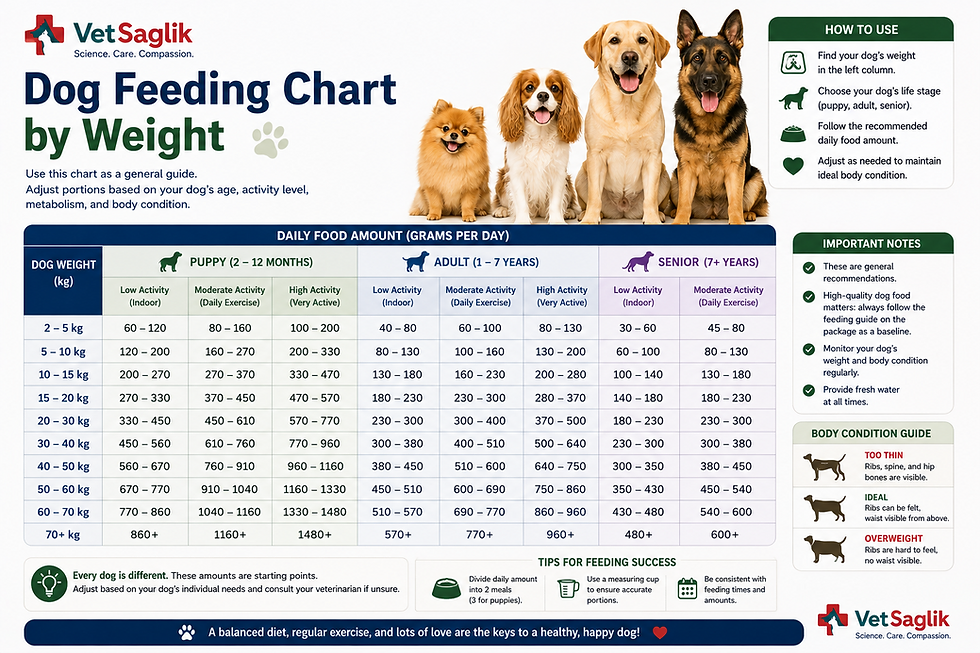
Dog Feeding Chart by Weight
The following chart estimates the daily dry-food amount for a healthy, neutered adult dog at ideal body condition. Calculations use approximately 1.6 × RER, but four different food energy densities are included because the correct gram amount changes considerably between products.
Dog’s weight | Estimated calories | 3,200 kcal/kg food | 3,600 kcal/kg food | 4,000 kcal/kg food | 4,500 kcal/kg food |
1 kg | 112 kcal | 35 g | 31 g | 28 g | 25 g |
2 kg | 188 kcal | 59 g | 52 g | 47 g | 42 g |
3 kg | 255 kcal | 80 g | 71 g | 64 g | 57 g |
4 kg | 317 kcal | 99 g | 88 g | 79 g | 70 g |
5 kg | 374 kcal | 117 g | 104 g | 94 g | 83 g |
7.5 kg | 508 kcal | 159 g | 141 g | 127 g | 113 g |
10 kg | 630 kcal | 197 g | 175 g | 157 g | 140 g |
15 kg | 854 kcal | 267 g | 237 g | 213 g | 190 g |
20 kg | 1,059 kcal | 331 g | 294 g | 265 g | 235 g |
25 kg | 1,252 kcal | 391 g | 348 g | 313 g | 278 g |
30 kg | 1,436 kcal | 449 g | 399 g | 359 g | 319 g |
40 kg | 1,781 kcal | 557 g | 495 g | 445 g | 396 g |
50 kg | 2,106 kcal | 658 g | 585 g | 468 g | |
60 kg | 2,415 kcal | 755 g | 671 g | 604 g | 537 g |
To use the chart:
Find the dog’s ideal weight in the first column.
Check the food label for its energy content in kcal/kg.
Select the closest energy-density column.
Use the listed amount as an initial estimate.
Subtract calories supplied by treats and other foods.
Monitor weight and body condition before making gradual adjustments.
If a food contains an energy density not shown in the table, use:
Daily grams = required daily calories ÷ (kcal/kg ÷ 1,000)
For example, a 15 kg dog requires an estimated 854 kcal daily and eats food containing 3,850 kcal/kg:
854 ÷ 3.85 = approximately 222 g/day
The table should not be used unchanged for puppies, intact highly active dogs, pregnant or lactating dogs, overweight dogs, or animals with medical conditions. It is also less reliable for dogs whose metabolism differs substantially from the average. The portion must be adjusted according to the dog’s real-world response.
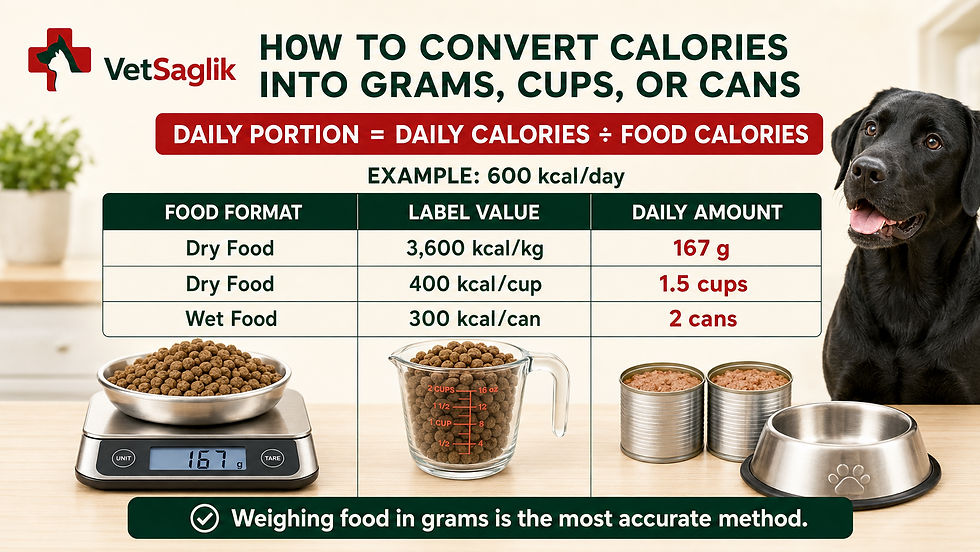
How to Convert Calories Into Grams, Cups, or Cans
Once the dog’s daily calorie requirement is known, it must be converted into the correct amount of the specific food being offered. The calculation differs depending on whether the label lists calories per kilogram, gram, cup, can, tray, or pouch.
Label information | Calculation |
kcal/kg | Divide by 1,000 to find kcal per gram |
kcal per cup | Daily calories ÷ kcal per cup |
kcal per can | Daily calories ÷ kcal per can |
kcal per pouch | Daily calories ÷ kcal per pouch |
kcal per 100 g | Divide daily calories by kcal per 100 g, then multiply by 100 |
Converting kcal/kg into grams
If a dry food contains 3,600 kcal/kg:
3,600 ÷ 1,000 = 3.6 kcal/g
If the dog needs 800 kcal daily:
800 ÷ 3.6 = approximately 222 g/day
Converting kcal/cup into cups
If the food provides 400 kcal per cup:
800 ÷ 400 = 2 cups/day
Cups are convenient but less precise than weighing food. Kibble size, shape, settling, and the way the cup is filled can change the actual amount. A digital kitchen scale is preferable, especially for small dogs and dogs undergoing weight management.
Converting kcal/can into cans
Suppose a 400 g can contains 440 kcal:
800 ÷ 440 = approximately 1.82 cans/day
This is equivalent to:
1.82 × 400 g = approximately 728 g/day
The following example shows how the same 800 kcal requirement produces very different serving sizes:
Food type | Energy information | Amount providing 800 kcal |
Dry food | 3,200 kcal/kg | 250 g |
Dry food | 3,600 kcal/kg | 222 g |
Dry food | 4,000 kcal/kg | 200 g |
Dry food | 400 kcal/cup | 2 cups |
Wet food | 440 kcal per 400 g can | 1.82 cans |
110 kcal per 100 g tray | 7.3 trays | |
Pouch food | 100 kcal per pouch | 8 pouches |
When dry and wet foods are combined, determine how many calories each food should contribute rather than estimating by volume.
For an 800 kcal daily target divided equally between dry and wet food:
Food | Calorie allocation | Energy density | Daily amount |
Dry food | 400 kcal | 3.6 kcal/g | 111 g |
Wet food | 400 kcal | 440 kcal/can | 0.91 can |
Total | 800 kcal | — | 111 g dry + approximately 0.9 can |
Treats, dental chews, table food, supplements, and food used to administer medication must be deducted from the daily target. If the dog receives 80 kcal from treats, only 720 kcal remains available for the main food.
Always use the calorie statement from the current package. Recipes and energy densities can differ between flavours, product lines, countries, and reformulated versions of the same food.
Puppy Feeding Chart by Age and Weight
Puppies require more calories relative to body weight than adult dogs because they are growing rapidly. Their daily requirement should be calculated from their current weight, not their predicted adult weight.
A commonly used starting method is:
Younger than 4 months: approximately 3 × RER
Older than 4 months and still growing: approximately 2 × RER
The following table shows estimated calories and dry-food amounts. The gram amounts assume a puppy food containing 4,000 kcal/kg, or 4 kcal/g.
Puppy’s current weight | Under 4 months: kcal/day | Under 4 months: g/day | Over 4 months: kcal/day | Over 4 months: g/day |
1 kg | 210 kcal | 53 g | 140 kcal | 35 g |
2 kg | 353 kcal | 88 g | 235 kcal | 59 g |
3 kg | 479 kcal | 120 g | 319 kcal | 80 g |
5 kg | 702 kcal | 176 g | 468 kcal | 117 g |
7.5 kg | 952 kcal | 238 g | 634 kcal | 159 g |
10 kg | 1,181 kcal | 295 g | 787 kcal | 197 g |
15 kg | 1,601 kcal | 400 g | 1,067 kcal | 267 g |
20 kg | 1,986 kcal | 497 g | 1,324 kcal | 331 g |
25 kg | 2,348 kcal | 587 g | 1,565 kcal | 391 g |
30 kg | 2,692 kcal | 673 g | 1,795 kcal | 449 g |
40 kg | 3,340 kcal | 835 g | 2,227 kcal | 557 g |
These amounts are estimates. To calculate the amount for another puppy food:
Daily grams = estimated calories ÷ food kcal per gram
Puppies should receive food labelled as complete and balanced for growth or for all life stages. Large- and giant-breed puppies should ideally receive a diet formulated for controlled large-breed growth, particularly because inappropriate energy and mineral intake can contribute to excessively rapid growth and skeletal problems.
Puppy age | Typical daily meal frequency |
6–12 weeks | 4 meals |
3–6 months | 3 meals |
6–12 months | 2 meals |
Large or giant breed still growing | Usually 2 meals |
Breed size affects when adult food becomes appropriate:
Expected adult size | Approximate transition period |
Around 9–12 months | |
Medium breed | Around 12 months |
Around 12–18 months | |
Giant breed | Around 18–24 months |
These transition ages are approximate. Skeletal maturity, body condition, growth rate, food formulation, and veterinary assessment are more useful than age alone.
A puppy’s portion should be reassessed frequently because body weight and energy needs change rapidly. Regular weighing and body-condition evaluation help prevent both inadequate growth and excessive calorie intake. Ribs should be easy to feel beneath a light fat covering, and the puppy should have a visible waist without appearing thin or bony.
How Much Should Adult and Neutered Dogs Eat?
Healthy adult dogs should receive enough food to maintain their ideal body weight, muscle mass, and body condition. Their daily intake varies considerably according to reproductive status and activity level.
Neutered dogs often require fewer calories than intact dogs. Hormonal changes may reduce energy expenditure while appetite remains unchanged or increases. Continuing the same portion after neutering can therefore lead to gradual weight gain.
The following table compares several starting factors:
Adult dog category | Starting calculation |
Inactive or strongly obesity-prone | 1.0–1.2 × RER |
Neutered adult with lower calorie needs | 1.4 × RER |
Typical neutered adult | 1.6 × RER |
Typical intact adult | 1.6–1.8 × RER |
Regularly active adult | Often 1.8–2.0 × RER |
Working or endurance dog | Individually calculated; may exceed 2.0 × RER considerably |
The next table shows how these factors affect calorie and food amounts. Gram values assume dry food containing 3,600 kcal/kg.
Weight | Low activity: 1.2 × RER | Neutered: 1.4 × RER | Neutered/active: 1.6 × RER | Intact/active: 1.8 × RER |
5 kg | 281 kcal / 78 g | 328 kcal / 91 g | 374 kcal / 104 g | 421 kcal / 117 g |
10 kg | 472 kcal / 131 g | 551 kcal / 153 g | 630 kcal / 175 g | 709 kcal / 197 g |
15 kg | 640 kcal / 178 g | 747 kcal / 208 g | 854 kcal / 237 g | 960 kcal / 267 g |
20 kg | 794 kcal / 221 g | 927 kcal / 258 g | 1,059 kcal / 294 g | 1,192 kcal / 331 g |
25 kg | 939 kcal / 261 g | 1,096 kcal / 304 g | 1,252 kcal / 348 g | 1,409 kcal / 391 g |
30 kg | 1,077 kcal / 299 g | 1,256 kcal / 349 g | 1,436 kcal / 399 g | 1,615 kcal / 449 g |
40 kg | 1,336 kcal / 371 g | 1,559 kcal / 433 g | 1,781 kcal / 495 g | 2,004 kcal / 557 g |
50 kg | 1,579 kcal / 439 g | 1,843 kcal / 512 g | 2,106 kcal / 585 g | 2,369 kcal / 658 g |
Neutering does not mean every dog should automatically be assigned the lowest multiplier. A neutered dog participating in regular sport or work may require more energy than an inactive intact dog. The multiplier must represent the individual dog rather than reproductive status alone.
Portions should be reviewed within the first few months after neutering. If body weight or waist definition begins to increase, the total daily calories may need to be reduced gradually. Treats and chews should be included before reducing the main food because hidden extras are a common source of excess calories.
Adult dogs should generally be fed measured meals rather than having unlimited access to food, especially when they are food-motivated or prone to obesity. Dividing the daily portion into two meals can improve portion control and make appetite easier to monitor.
How Much Food Should Senior Dogs Eat?
There is no universal calorie multiplier or food amount for every senior dog. Many older dogs require fewer calories because they become less active and lose metabolically active lean tissue. Others lose weight and muscle because of dental disease, reduced digestion, chronic illness, or decreased appetite and may need a more energy-dense diet.
A dog should therefore not receive less food simply because it has reached a certain age.
Senior dog’s condition | Possible feeding response |
Stable weight, ideal body condition, good muscle mass | Maintain the current calorie intake |
Gradual fat gain with reduced activity | Reduce total calories carefully and monitor |
Loss of muscle but stable or increasing fat | Review protein intake, activity, and underlying disease |
Unexplained weight loss | Arrange veterinary examination before increasing food |
Reduced appetite | Investigate dental disease, pain, nausea, medication effects, and systemic illness |
Difficulty chewing | Consider an appropriate softer food or moistened diet |
Poor digestion or large stool volume | Review digestibility and gastrointestinal health |
Kidney, liver, heart, pancreatic, or endocrine disease | Use an individually selected therapeutic feeding plan |
Senior dogs benefit from monitoring that considers both body condition and muscle condition:
What to monitor | Suggested frequency |
Body weight | Every 2–4 weeks after a dietary change |
Body Condition Score | Monthly at home and during veterinary visits |
Muscle Condition Score | During routine veterinary examinations |
Appetite and meal completion | Daily |
Water intake and urination | Daily |
Stool quality | Daily |
Mobility and activity | Regularly |
Unexplained weight or appetite changes | Veterinary assessment without delay |
When calorie reduction is appropriate, the change should usually be gradual. A reduction of approximately 5–10% from the current measured intake can be followed by reassessment rather than making a sudden major restriction. Severe restriction of ordinary maintenance food may reduce the intake of protein, vitamins, and minerals along with calories.
Senior dogs should not automatically be placed on a low-protein diet. Adequate high-quality protein is important for preserving lean muscle unless a specific medical condition requires dietary modification. The appropriate food should be chosen according to body condition, muscle mass, digestive tolerance, dental health, and diagnosed disease—not the word “senior” alone.
Unexplained weight loss, muscle wasting, excessive thirst, vomiting, diarrhea, appetite changes, or difficulty eating should not be treated solely by changing portions. These signs may indicate an underlying condition that requires examination and diagnostic testing.
Dry Food, Wet Food, or Mixed Feeding: How Much Should You Give?
Dry and wet foods contain very different amounts of water and calories. For this reason, their portions cannot be compared gram for gram. A dog may need several times more wet food by weight to receive the same number of calories provided by dry kibble.
Feature | Dry food | Wet food |
Typical moisture | Approximately 10–12% | Approximately 75–78% |
Typical calorie density | Approximately 300–450 kcal/100 g | Approximately 70–140 kcal/100 g |
Portion size by weight | Smaller | Larger |
Measurement | Preferably weighed in grams | Grams, cans, trays, or pouches |
Storage after opening | Usually easier | Usually requires refrigeration |
Water contribution | Low | High |
Feeding cost per calorie | Often lower | Often higher |
Palatability | Varies | Often highly palatable |
These calorie ranges are illustrative. The exact calorie statement on the package must always be used because some products fall outside these ranges.
The following example compares foods for a dog requiring 600 kcal per day:
Food | Energy density | Daily amount for 600 kcal |
Lower-calorie dry food | 3,200 kcal/kg | 188 g |
Moderate-calorie dry food | 3,600 kcal/kg | 167 g |
Energy-dense dry food | 4,200 kcal/kg | 143 g |
Wet food | 900 kcal/kg | 667 g |
Wet food | 1,100 kcal/kg | 545 g |
Wet food | 1,300 kcal/kg | 462 g |
A larger wet-food portion does not necessarily mean the dog is receiving more calories. Much of the additional weight comes from water.
Mixed feeding
Dry and wet foods can be combined, but each must be counted as part of the same daily calorie allowance. Giving the full recommended dry portion and then adding wet food usually results in overfeeding.
For a dog requiring 600 kcal daily, a 50:50 calorie split could look like this:
Food component | Calorie allocation | Food energy density | Required amount |
Dry food | 300 kcal | 3,600 kcal/kg | 83 g |
Wet food | 300 kcal | 1,000 kcal/kg | 300 g |
Daily total | 600 kcal | — | 83 g dry + 300 g wet |
Another dog may receive 75% of its calories from dry food and 25% from wet food:
Food component | Calorie allocation | Required amount |
Dry food at 3.6 kcal/g | 450 kcal | 125 g |
Wet food at 1 kcal/g | 150 kcal | 150 g |
Daily total | 600 kcal | 125 g dry + 150 g wet |
The combined diet should remain complete and balanced for the dog’s life stage. Adding large quantities of meat, rice, vegetables, or other foods to a commercial diet can dilute essential nutrients even when the total calorie amount appears correct.
When switching between dry and wet food, introduce the new diet gradually over several days unless a veterinarian recommends otherwise. Sudden dietary changes can cause vomiting, diarrhea, flatulence, or food refusal.
How Many Meals Should a Dog Eat Per Day?
The dog’s total daily amount should be calculated first and then divided into meals. Meal frequency changes how the food is distributed, but it should not increase the total daily calorie allowance.
Dog’s age or condition | Typical meals per day |
Recently weaned puppy, approximately 6–12 weeks | 4 meals |
Puppy, approximately 3–6 months | 3 meals |
Puppy, approximately 6–12 months | 2 meals |
Healthy adult dog | 2 meals |
Healthy senior dog | 2 meals, sometimes 3 smaller meals |
Small dog prone to long fasting periods | 2–3 meals |
Pregnant dog in late pregnancy | 3 or more smaller meals |
Lactating dog | Multiple meals or individualized access |
Dog with a medical condition | As directed by the veterinarian |
For most healthy adult dogs, two measured meals per day provide a practical balance between appetite control, digestive comfort, and routine. Feeding the entire daily amount in one meal may be less comfortable, particularly for large dogs or dogs that eat rapidly.
The daily portion should be divided accurately:
Daily food allowance | Two meals | Three meals | Four meals |
100 g | 50 g each | Approximately 33 g each | 25 g each |
200 g | 100 g each | Approximately 67 g each | 50 g each |
300 g | 150 g each | 100 g each | 75 g each |
500 g | 250 g each | Approximately 167 g each | 125 g each |
800 g | 400 g each | Approximately 267 g each | 200 g each |
Free-choice feeding, where food remains available throughout the day, makes it difficult to measure intake and identify early appetite changes. It may also encourage overeating in food-motivated dogs. Measured meals are generally preferable for weight control and monitoring.
Large and deep-chested dogs may benefit from having their daily amount divided into at least two meals rather than receiving one very large portion. Rapid eating should also be managed with an appropriate slow-feeding method when necessary. Vigorous exercise should be avoided immediately around large meals, particularly in dogs considered at increased risk of gastric dilatation-volvulus.
Some medical conditions require different schedules. Dogs receiving insulin, certain medications, or therapeutic diets may need meals given at consistent times. Dogs with gastrointestinal disease, swallowing problems, or reduced stomach capacity may tolerate smaller, more frequent meals better. These schedules should be planned with the treating veterinarian.
How Much of a Dog’s Daily Intake Can Come From Treats?
Treats, table food, chews, dental products, and food used to administer medication should generally provide no more than 10% of a healthy dog’s total daily calories. At least 90% should come from a complete and balanced diet appropriate for the dog’s life stage.
Daily calorie requirement | Maximum calories from treats | Calories remaining for complete food |
200 kcal | 20 kcal | 180 kcal |
300 kcal | 30 kcal | 270 kcal |
400 kcal | 40 kcal | 360 kcal |
500 kcal | 50 kcal | 450 kcal |
600 kcal | 60 kcal | 540 kcal |
800 kcal | 80 kcal | 720 kcal |
1,000 kcal | 100 kcal | 900 kcal |
1,200 kcal | 120 kcal | 1,080 kcal |
1,500 kcal | 150 kcal | 1,350 kcal |
2,000 kcal | 200 kcal | 1,800 kcal |
The 10% limit is a maximum rather than a daily target. Dogs do not need treats to meet their nutritional requirements, and overweight dogs may benefit from receiving considerably less.
Treat calories can accumulate quickly:
Extra food | Example calorie value |
Small training treat | 3–10 kcal |
Larger dog biscuit | 30–100 kcal |
Dental chew | 50–150 kcal or more |
Small piece of cheese | 40–70 kcal |
Spoonful of peanut butter | 80–100 kcal |
Food used to hide medication | Varies by product and amount |
These values are examples only. Product labels or manufacturer information should be checked whenever possible.
Consider a 10 kg dog with a target of 600 kcal per day:
Daily item | Calories |
Complete dog food | 540 kcal |
Training treats | 25 kcal |
Dental chew | 35 kcal |
Total | 600 kcal |
If the owner feeds the full 600 kcal portion of dog food and then adds the same treats and dental chew, the dog receives 660 kcal. This represents a 10% daily excess and may result in gradual weight gain.
Treats should be measured at the beginning of the day rather than given directly from the package. Part of the dog’s normal kibble allowance can be reserved for training, reducing the need for additional calories.
Low-calorie alternatives may include small pieces of a safe vegetable, but even these should remain limited. Foods containing xylitol, chocolate, grapes, raisins, onions, garlic, macadamia nuts, alcohol, or large amounts of fat should never be offered.
How to Adjust Portions Using Body Condition Score
Calculated calorie requirements and package feeding instructions are only starting points. The dog’s Body Condition Score, or BCS, helps determine whether the current portion is maintaining an appropriate amount of body fat.
The commonly used nine-point scale considers the ribs, waist, abdominal tuck, and fat deposits.
BCS | General interpretation | Typical physical findings |
1/9 | Emaciated | Ribs, spine, and pelvic bones clearly visible; severe loss of fat and muscle |
2/9 | Very thin | Ribs easily visible; minimal fat; marked waist and abdominal tuck |
3/9 | Thin | Ribs easy to feel and may be visible; pronounced waist |
4/9 | Lean and generally ideal | Ribs easy to feel with minimal fat covering; clear waist |
5/9 | Ideal | Ribs easily felt beneath a light fat covering; visible waist and abdominal tuck |
6/9 | Slightly overweight | Ribs palpable with mild excess covering; waist less obvious |
7/9 | Overweight | Ribs difficult to feel; noticeable fat deposits; limited waist |
8/9 | Obese | Ribs difficult or impossible to feel; heavy fat deposits; little abdominal tuck |
9/9 | Severely obese | Extensive fat deposits; no visible waist; abdominal enlargement |
A healthy target for many dogs is approximately 4–5 out of 9. Breed shape should be considered, but breed characteristics do not eliminate the health effects of excessive body fat.
Observation | Possible action |
BCS 4–5/9 and stable weight | Maintain the current daily intake |
BCS 3/9 or declining weight | Investigate the cause and consider a controlled increase |
BCS 6/9 with gradual weight gain | Review treats and reduce total intake carefully |
BCS 7–9/9 | Arrange a structured veterinary weight-management plan |
Normal BCS but visible muscle loss | Assess Muscle Condition Score and investigate disease |
Rapid or unexplained weight change | Seek veterinary evaluation before making major adjustments |
For a healthy dog with mild unwanted weight gain, the current accurately measured intake may be reduced by approximately 5–10%, followed by reassessment. Sudden severe restriction is not recommended.
Current daily portion | 5% reduction | 10% reduction |
100 g | 95 g | 90 g |
150 g | 143 g | 135 g |
200 g | 190 g | 180 g |
300 g | 285 g | 270 g |
400 g | 380 g | 360 g |
500 g | 475 g | 450 g |
Weight and BCS should be checked again after approximately two to four weeks. If the dog continues gaining weight, confirm that every household member follows the same plan and that treats, chews, table food, and scavenged food have been included.
Body condition does not assess muscle mass. A senior or chronically ill dog may have excess body fat while simultaneously losing muscle. These dogs should be evaluated with both Body Condition Score and Muscle Condition Score rather than simply receiving a lower portion.
Signs You May Be Feeding Your Dog Too Much or Too Little
The feeding amount is probably appropriate when the dog maintains a stable ideal weight, has a Body Condition Score of approximately 4–5/9, preserves healthy muscle mass, and produces consistently normal stools.
Signs of excessive and insufficient intake can overlap with medical conditions. Changes should therefore be interpreted alongside appetite, activity, stool quality, medications, and general health.
Area assessed | Possible overfeeding | Possible underfeeding |
Body weight | Progressive weight gain | Progressive weight loss |
Ribs | Difficult to feel beneath fat | Highly prominent or visible |
Waist | Reduced or absent | Excessively narrow or pronounced |
Abdomen | Little abdominal tuck or sagging appearance | Marked abdominal tuck |
Fat deposits | Increased over ribs, spine, tail base, and abdomen | Minimal body-fat covering |
Energy | Reduced stamina or exercise intolerance | Weakness, lethargy, or restlessness |
May still appear hungry despite excess intake | Persistent hunger or food-seeking | |
Stool | Larger, more frequent, or softer stools | Small stool volume or constipation in some cases |
Mobility | Greater joint strain and reluctance to exercise | Weakness and reduced muscle strength |
Coat and skin | May remain normal; problems can occur with an unbalanced diet | Dull coat, poor skin quality, or delayed healing |
Muscle mass | May be hidden beneath excess fat | Muscle loss over the spine, skull, shoulders, or hips |
A dog acting hungry does not automatically need more food. Some dogs remain highly food-motivated even when receiving excess calories. Hunger-like behavior may also be influenced by routine, boredom, competition with other pets, medication, or disease.
Likewise, weight loss does not always mean the portion is too small. Dental disease, intestinal disorders, parasites, diabetes, kidney disease, liver disease, cancer, and other conditions may cause weight loss despite adequate or increased food intake.
Finding | Recommended response |
Slow weight gain with normal health | Measure all foods and review total calories |
Slow weight loss after an intentional reduction | Continue monitoring according to the weight plan |
Unexpected weight loss | Arrange a veterinary examination |
Rapid weight gain | Review intake, medication, activity, and endocrine health |
Constant hunger with weight loss | Seek veterinary evaluation |
Refusal to eat | Assess urgency according to duration and accompanying symptoms |
Vomiting, diarrhea, or abdominal discomfort | Stop relying solely on portion adjustment and obtain advice |
Loss of muscle despite stable weight | Evaluate diet quality and underlying disease |
The portion should be changed gradually unless the veterinarian recommends a different approach. Accurate weighing is important because estimates such as “one bowl” or “a handful” make it difficult to determine whether the dog is receiving too much or too little.
When Should a Veterinarian Calculate Your Dog’s Diet?
General feeding charts are designed primarily for healthy dogs. A veterinarian or veterinary nutrition professional should calculate or review the diet when the dog has a medical condition, abnormal body condition, unusual energy requirements, or an unexplained change in appetite or weight.
Situation | Why an individualized plan may be needed |
Safe calorie restriction must preserve protein, vitamins, and minerals | |
Severe underweight condition | Rapid refeeding can be unsafe in some patients |
Meal composition, amount, and timing may need coordination with insulin | |
Protein, phosphorus, sodium, energy, and hydration may require adjustment | |
Diet depends on diagnosis, disease severity, and complications | |
Fat intake may need careful control | |
Sodium and calorie intake may require modification | |
Digestibility, fiber, fat, protein source, or meal frequency may need adjustment | |
Food allergy or adverse food reaction | A structured elimination diet may be necessary |
Mineral content, urine dilution, and therapeutic formulation may be important | |
Pregnancy or lactation | Calorie needs change rapidly and may become very high |
Large- or giant-breed puppy growth | Excess energy and inappropriate mineral intake can affect skeletal development |
Working or endurance activity | Requirements vary according to workload and environmental conditions |
Dental or swallowing problems | Food texture and meal delivery may require adaptation |
Long-term medication use | Some medications alter appetite, weight, or metabolism |
Home-prepared diet | Nutrient balance cannot be confirmed from calories alone |
Immediate professional assessment is appropriate when a dog stops eating and is also vomiting, unusually weak, painful, bloated, dehydrated, struggling to breathe, or showing neurological signs. Puppies, very small dogs, diabetic dogs, and dogs with existing disease may become unstable more quickly than healthy adults.
A nutritional assessment may include:
Current and ideal body weight
Body Condition Score
Muscle Condition Score
Complete diet and treat history
Exact food calorie density
Activity and lifestyle
Life stage and reproductive status
Medical history and medications
Laboratory or diagnostic findings
Follow-up weight and body measurements
A diet is not appropriate solely because its calorie total matches the calculation. It must also provide the correct balance of protein, fat, essential fatty acids, vitamins, minerals, and other nutrients for the dog’s life stage and health.
Home-prepared diets require particular care. Meat, rice, vegetables, eggs, and supplements combined without a professionally formulated recipe may provide enough calories while remaining deficient or excessive in essential nutrients. A recipe intended for long-term feeding should be formulated by a qualified veterinary nutrition specialist.
Frequently Asked Questions
How much food should a dog eat per day?
The correct amount depends on the dog’s ideal weight, age, activity, reproductive status, body condition, health, and the food’s calorie density. Calculate the daily calorie requirement first, then divide it by the food’s calories per gram, cup, can, or pouch.
How many grams of dry food should I feed my dog?
There is no universal gram amount based only on weight. A 10 kg dog requiring 600 kcal would need approximately 188 g of food containing 3,200 kcal/kg but only 133 g of food containing 4,500 kcal/kg. Always check the specific product’s calorie statement.
Can I follow the feeding chart on the dog food package?
Package directions provide a useful starting point but may overestimate or underestimate an individual dog’s needs. Monitor weight, Body Condition Score, muscle condition, activity, and treats, then adjust the measured portion gradually.
Should dog food be measured in cups or grams?
Grams are more accurate. Cups can produce inconsistent portions because kibble size, density, and the way the cup is filled vary. A digital kitchen scale is particularly useful for small dogs, overweight dogs, and calorie-dense foods.
How many cups of food should a dog eat daily?
Divide the dog’s daily calorie requirement by the food’s calories per cup. For example, a dog requiring 800 kcal would need two cups of a food providing 400 kcal per cup. Cups from different foods are not nutritionally or calorically equivalent.
Should dogs eat once or twice a day?
Most healthy adult dogs benefit from two measured meals per day. Puppies generally require three or four meals depending on age, while senior dogs and dogs with certain medical conditions may benefit from smaller, more frequent meals.
Do neutered dogs need less food?
Many neutered dogs require fewer calories and may become more food-motivated. Their weight and body condition should be monitored after neutering, and total calories should be adjusted if unwanted weight gain begins.
How much should a puppy eat per day?
A commonly used starting estimate is approximately 3 × RER for puppies younger than four months and 2 × RER after four months while growth continues. The calculation uses the puppy’s current weight. Food should be complete and balanced for growth.
How much wet food should I feed my dog?
Divide the dog’s daily calorie requirement by the wet food’s calories per can, pouch, tray, or gram. Wet foods contain much more water than dry foods, so the portion will usually be larger by weight.
Can I mix wet and dry dog food?
Yes, provided both foods are appropriate for the dog and their combined calories remain within the daily allowance. Do not feed the full recommended dry portion and then add wet food without reducing the dry amount.
How much of a dog’s diet can consist of treats?
Treats and other extras should generally provide no more than 10% of the dog’s total daily calories. At least 90% should come from a complete and balanced diet appropriate for the dog’s life stage.
How do I know whether I am overfeeding my dog?
Common signs include progressive weight gain, ribs becoming difficult to feel, loss of waist definition, reduced abdominal tuck, and declining exercise tolerance. A Body Condition Score above 5/9 suggests that the feeding plan should be reviewed.
Why is my dog always hungry despite eating enough?
Food-seeking can be caused by habit, boredom, competition, highly palatable food, medication, or individual temperament. Persistent hunger accompanied by weight loss, excessive thirst, vomiting, diarrhea, or other changes requires veterinary evaluation.
When should I change my dog’s daily portion?
Review the portion when the dog gains or loses unintended weight, changes food, is neutered, enters a new life stage, becomes more or less active, starts medication, or develops a medical condition. Reassess weight and body condition after every adjustment.
Sources
Official source | Open link |
World Small Animal Veterinary Association — Global Nutrition Guidelines | |
American Animal Hospital Association — Feeding Plans for Healthy, Appropriate-Weight Dogs and Cats | |
American Animal Hospital Association — Weight Reduction in the Obese Pet | |
American Animal Hospital Association — Age-Specific and Breed-Specific Diets | |
American Animal Hospital Association — Senior Dog and Cat Nutrition | |
Merck Veterinary Manual — Daily Maintenance Energy Requirements for Dogs and Cats | |
Merck Veterinary Manual — Nutritional Requirements of Small Animals | |
U.S. Food and Drug Administration — Complete and Balanced Pet Food | |
Association of American Feed Control Officials — Reading Pet Food Labels | |
Association of American Feed Control Officials — Calorie Content | |
Mersin Vetlife Veterinary Clinic | |


Comments